Growth is exciting.
More customers, more markets, more transactions, more teams and more capital all appear to validate the business—and create pressure to chase the next milestone.
But not all growth strengthens a business. Some growth makes the company more valuable, more efficient and more capable. Other growth makes it larger and more complex, while increasing its dependence on fresh capital.
The difference is not always visible in the topline.
The more useful questions are:
Are we growing? And are we growing right?
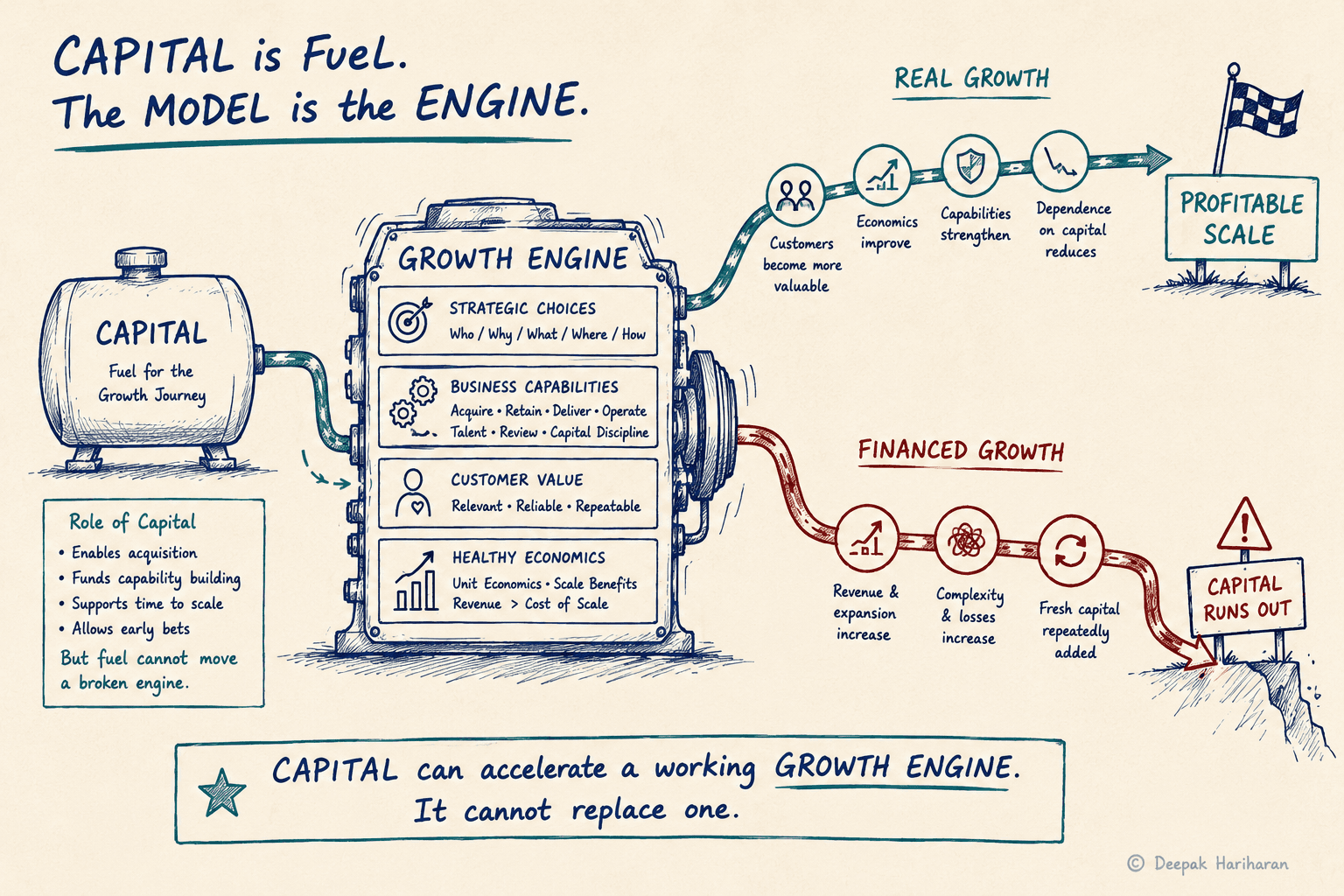
The visible growth problem may be slow acquisition, lower conversion or missed revenue targets. But the Real Constraint may sit in Who the business serves, the Value Proposition, the Product-Pricing combination, the Market, the Channel or the Business Capabilities required to execute these choices.
In this article, we will cover three key elements:
1 - Strategic Choices determine Growth - Choices around Who / Why / What / Where / How determine the direction and quality of Growth.
2 - Growth is more than Expansion - Expansion can increase the size of the company without improving Customer Value, economics or capabilities.
3 - Capital is Fuel, not the Engine - In the Proving Stage, capital helps test and establish whether the model works. In the Scaling Stage, it should accelerate a proven model, not replace the engine or hide the Real Constraint. Real Growth strengthens the business from within, while Financed Growth survives from funding round to funding round.
1 - Strategic Choices determine Growth
Growth is the result of a series of choices about Who / Why / What / Where / How.
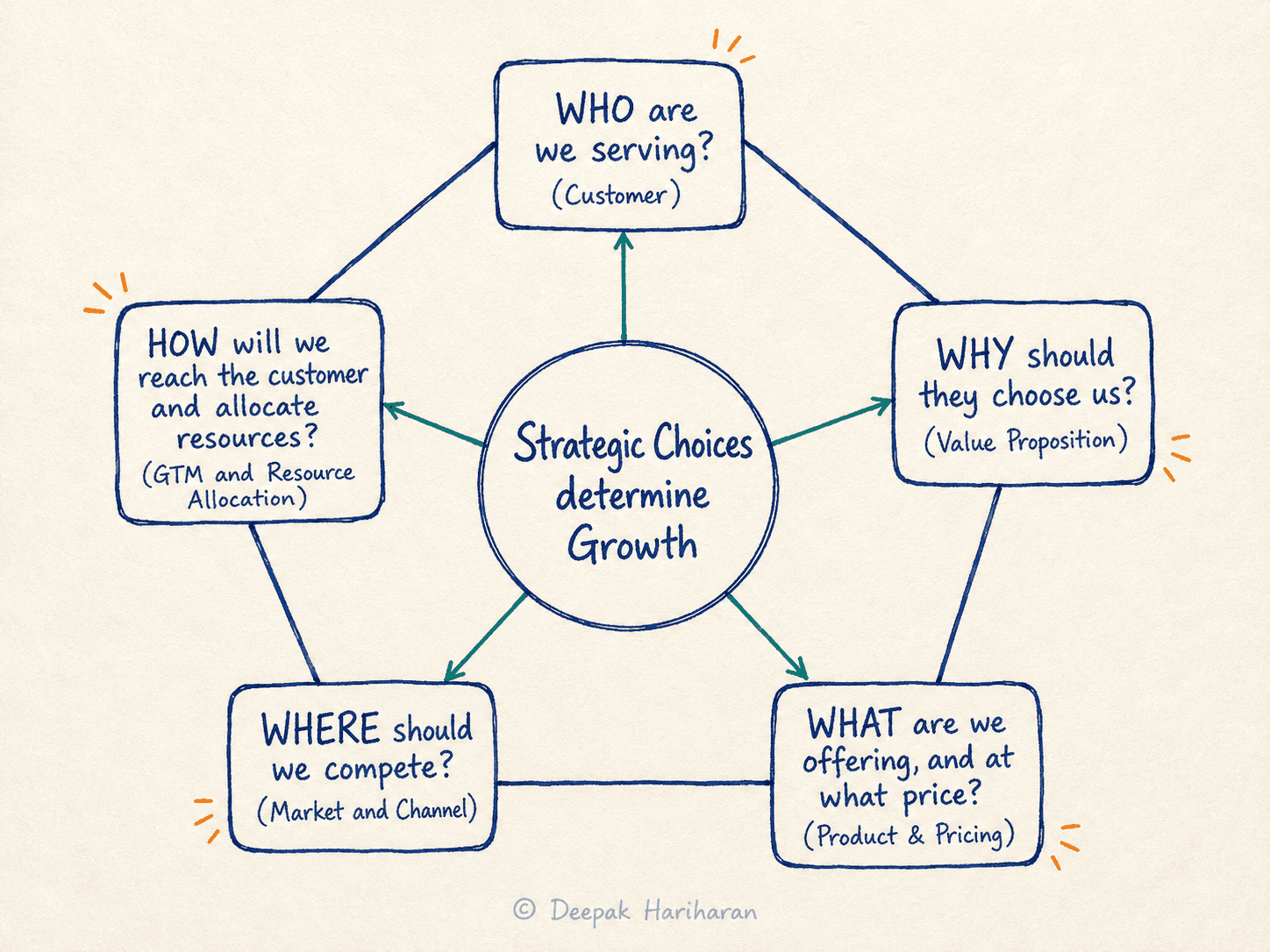
A - WHO are we serving?
Broad-based targeting seldom works unless the product has near-universal appeal. Different customers can have very different needs, buying behaviour and economics.
The right customers may have a more critical need, retain longer, buy more frequently, be willing to pay more, cost less to serve or refer more customers. Early product testing and market response should help the business understand where it is seeing the strongest fit.
The first growth choice is therefore not simply how many customers to acquire. It is which customers the business is best placed to serve.
B - WHY should they choose us?
The Value Proposition must solve a relevant need and be compelling enough for the customer to act. Positioning, the articulation of benefit and the sales pitch determine whether that value is understood.
A business can generate transactions through discounts, distribution strength or sales effort even when its proposition is weak. This may support short-term revenue, but it is unlikely to create strong retention.
The customer must experience enough value to choose the business again.
C - WHAT are we offering, and at what price?
Product and Pricing choices shape both growth and economics.
A broader product portfolio may attract more customers, but it can also increase complexity. A lower price may improve conversion while weakening contribution. A premium offer may reduce volumes but attract customers with a stronger need and a better fit.
The objective is not the widest portfolio or the lowest price. It is the Product-Pricing combination that creates enough value for the customer and for the business.
D - WHERE should we compete?
The choice of Markets and Channels is not only about access to demand. It also determines the quality of the customers acquired and the economics of serving them.
A market or channel may create high initial volumes but limited repeat business. Another may grow more slowly but produce stronger retention, lower acquisition costs or greater customer value.
Leaders therefore need to ask whether to go deeper in an existing Market or expand across more geographies, and whether to build depth in one Channel or spread across several. They should also compare conversion, Retention and CAC across these choices.
The question is not only, “Where is the demand?” It is also, “Where do we have the right to win?”
E - HOW will we reach the customer and allocate resources?
Go-to-market design, sales structure, partnerships, capital allocation and leadership attention determine whether the earlier choices translate into outcomes.
Businesses often spread resources across too many growth bets. The organization appears busy, but no individual bet receives enough attention or is supported by the capabilities required to succeed.
Growth improves when leaders make sharper choices about what to fund, what to deprioritise and what to stop. These choices must then be reviewed against actual customer and business outcomes and course-corrected as the market responds.
2 - Growth is more than Expansion
Businesses often describe growth through visible expansion: more customers, products, channels, cities, employees or offices.
These may all be signs of growth. They are not proof that the business is becoming stronger.
A business may add customers while retention falls. It may enter new markets while losses rise. It may expand its portfolio while complexity increases faster than revenue. It may raise more capital while the path to self-sustaining growth remains unclear.
Expansion increases the surface area of the business. Real growth should also improve what lies underneath: customer value, economics, brand and trust, operating leverage, business capabilities and repeatable systems.
This distinction is often hidden by aggregate reporting. Revenue may be growing even when one market, channel, product or customer segment is weakening the business.
The quality of growth therefore matters as much as the rate of growth.
3 - Capital is Fuel, not the Engine
Capital plays an important role in the journey of a business, but its role changes as the company evolves.
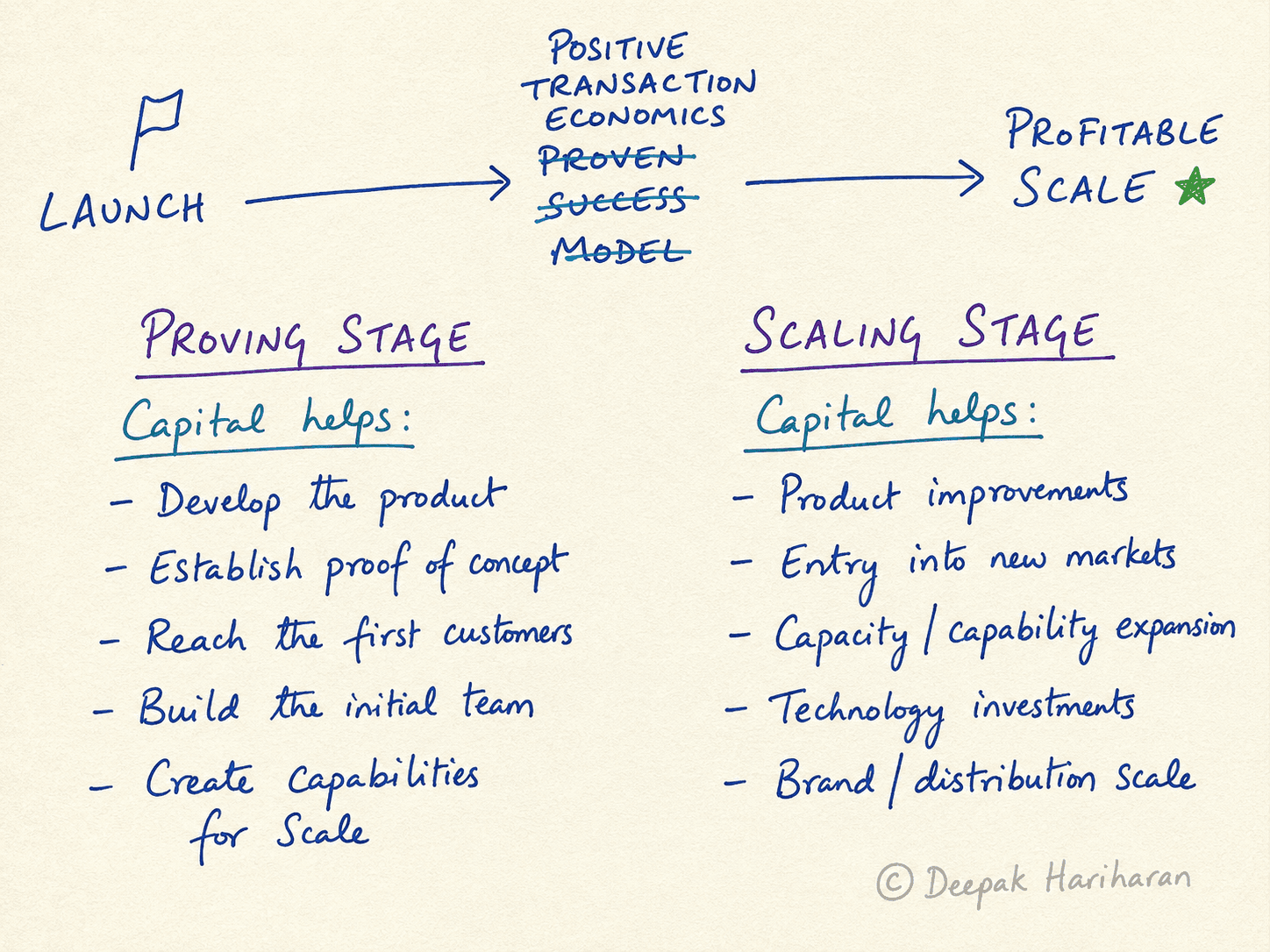
In the Proving Stage, capital helps develop the product, reach the first customers, test the proposition, build the initial team and learn what works. The economic destination of this stage is Positive Transaction Economics.
The company does not need to be profitable at the overall level yet. It may still be investing ahead of revenue in technology, talent, product development or market creation. But it must begin to prove that the underlying transaction or customer relationship can create value in at least one meaningful context. Capital can support testing and learning during this stage - but it cannot permanently turn an economically weak transaction into a strong one.
Once the wider model has demonstrated repeatable demand, sustained Customer Value and credible economics, the business enters the Scaling Stage. Capital can now accelerate customer acquisition, product improvement, capacity creation, technology, market expansion and the Business Capabilities needed for scale. The destination of this stage is Profitable Scale.
In the Proving Stage, capital helps establish whether the engine works. In the Scaling Stage, it helps a working engine move faster. The problem begins when capital is expected to replace the engine.
Real Growth and Financed Growth
Real Growth strengthens the business from within. As the company scales, customers become more valuable, the model becomes more predictable, economics improve and the institution becomes more capable of sustaining performance. Dependence on external capital gradually reduces.
Financed Growth can look similar from the outside. Revenue rises, the customer base expands and the organization becomes larger. But the underlying business continues to depend on fresh capital to fund acquisition, discounts, weak contribution, excess capacity, operating complexity or losses from expansion.
Financed Growth survives from funding round to funding round.
A useful question is:
If external capital became unavailable tomorrow, what part of the growth engine would continue to work?
This is not an argument against raising or deploying capital. Capital can help a good business prove its model and reach its potential faster.
But leadership should be clear about what the capital is doing. Is it helping the business test and prove a model? Is it accelerating a model that already works? Or is it delaying difficult decisions about Customer, Value Proposition, Product, Pricing, Market, Channel or Go-to-market?
A shortage of capital can kill a good business prematurely. But an abundance of capital can also allow a weak model to become large and difficult to repair.
When should Capital accelerate Growth?
Capital should accelerate growth when the leadership team has enough evidence that the next layer of investment will strengthen a working model.
That does not require the business to have solved everything. But the leadership should understand which customers create the strongest value, why they choose the business, which Product-Pricing combination works, which Markets and Channels produce the right demand, and which Business Capabilities must be strengthened for the next stage.
There should also be evidence that growth is improving—or has a credible path to improving—the economics of the business. At this point, capital can help the company move faster than internally generated cash would allow.
Before this point, more capital may hide the Real Constraint. The usual growth question is, “How do we grow faster?”
A better place to begin is: Which growth should we choose? That choice should not be based on aggregate Revenue or instinct alone. It requires diagnosing the quality of Growth.
Diagnosing the Quality of Growth
Revenue Growth is the visible Outcome Metric, but it does not tell us whether Growth is strengthening the business.
The diagnostic should disaggregate Growth into new-customer acquisition, existing-customer Retention, purchase frequency, ticket size or ARPU. These should then be examined across Customer segments, Products, Channels and Markets.
Relevant Health Metrics may include conversion, CAC, Retention, Contribution Margin and payback period. These help reveal whether the Real Constraint sits in Customer choice, the Value Proposition, Pricing, Market, Channel or the Business Capabilities required to execute these choices.
The purpose is not merely to explain why Growth is slower than expected. It is to identify the Real Constraint and determine which Growth should be accelerated, refined or stopped.
Before You Move On
Complete these three sentences:
Our next growth milestone is __________________.
The Real Constraint preventing us from achieving this milestone is __________________.
The highest-leverage action we will take now is __________________.
If these questions surface an important issue about the quality of growth in your business, I am always open to a thoughtful conversation.