Every entrepreneur begins with a large ambition: to solve an important customer problem, build an enduring institution and leave behind a legacy.
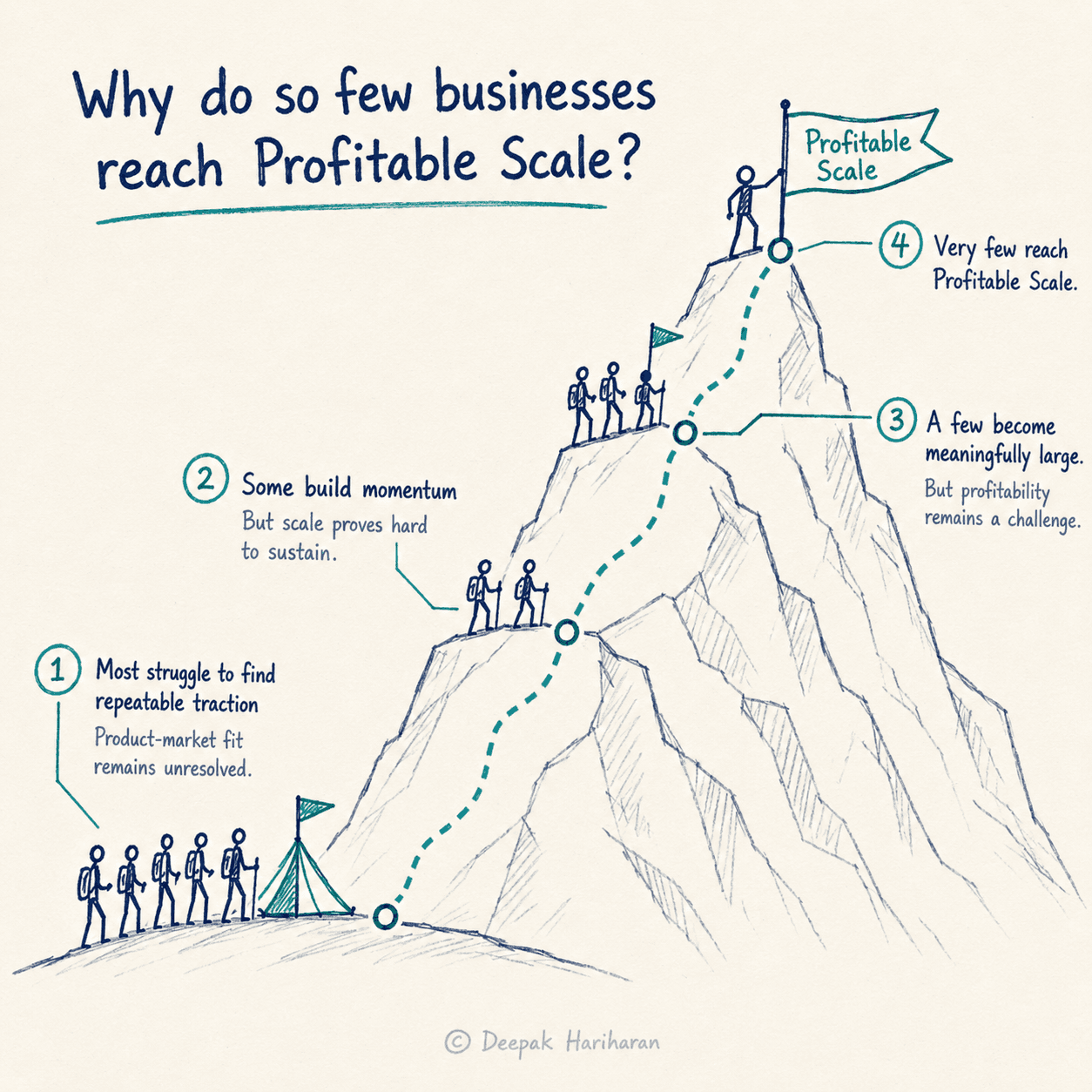
Yet very few businesses achieve meaningful scale, healthy profitability and the institutional strength to sustain both. Why do so many fall behind?
What really is “Profitable Scale”?
Profitable Scale is when a business achieves MEANINGFUL REVENUE SCALE and HEALTHY PROFITABILITY, and has built the INSTITUTIONS AND SYSTEMS required for LONG-TERM SUCCESS.
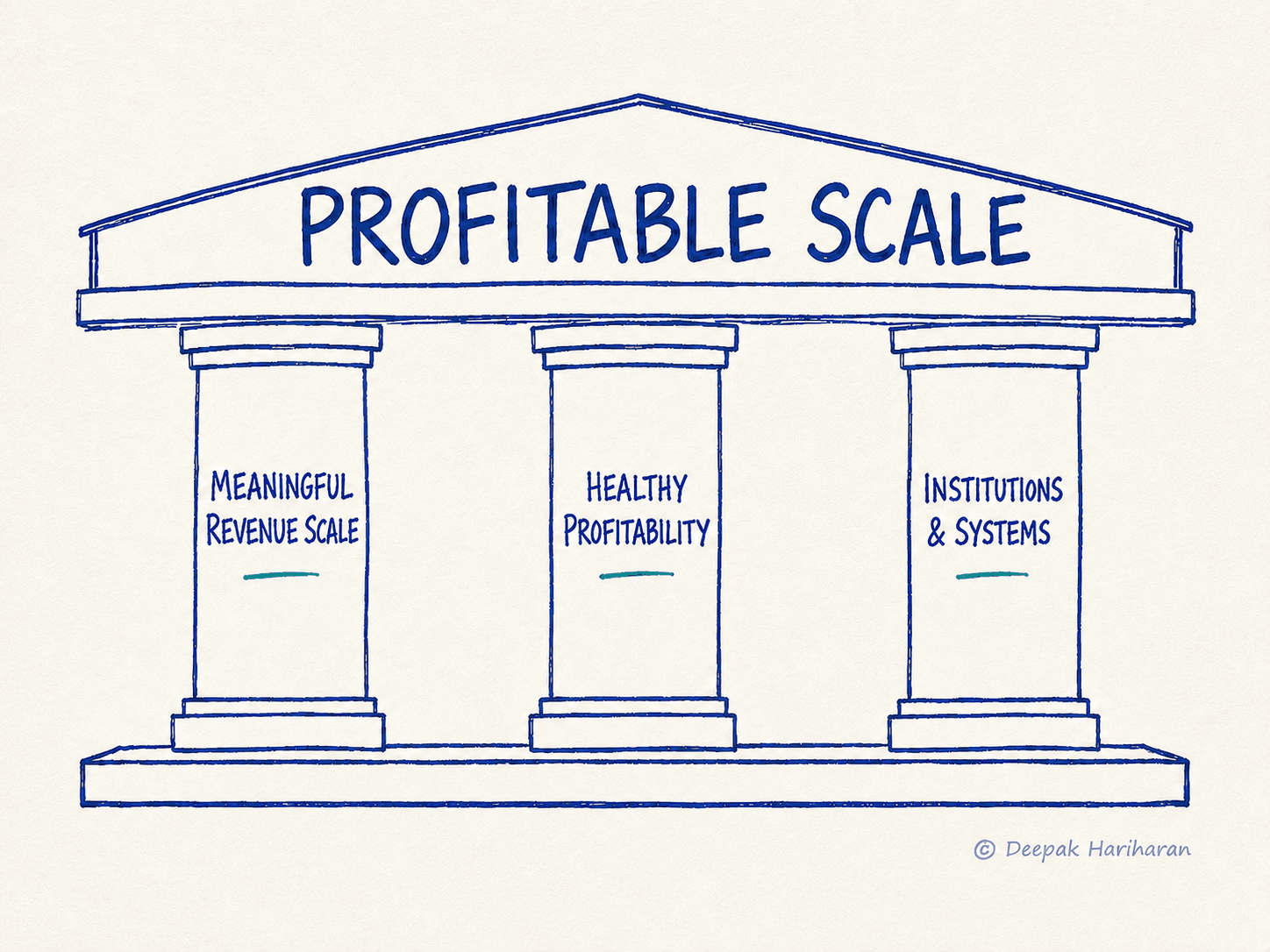
The three pillars of Profitable Scale are:
Meaningful Revenue Scale - The business has moved beyond proving demand and established a material market presence. Without it, significant market potential may remain untapped.
Healthy Profitability - The business has a structurally healthy path to margins, cash flow and returns; it is not growing by weakening its underlying economics. Without it, growth remains dependent on continuous capital infusion.
Institutions and Systems - Repeatable systems, aligned teams, decision discipline and execution capability have been built. Performance no longer depends on founder heroics or individual effort alone.
Each pillar is crucial to long-term success, enabling the business to endure competition, complexity, economic cycles and leadership transitions.
Companies do not achieve Profitable Scale accidentally.
Outcomes are influenced by many factors. Within their circle of influence, leaders can deliberately shape two things - the Strategic Choices they make and the Business Capabilities they build.
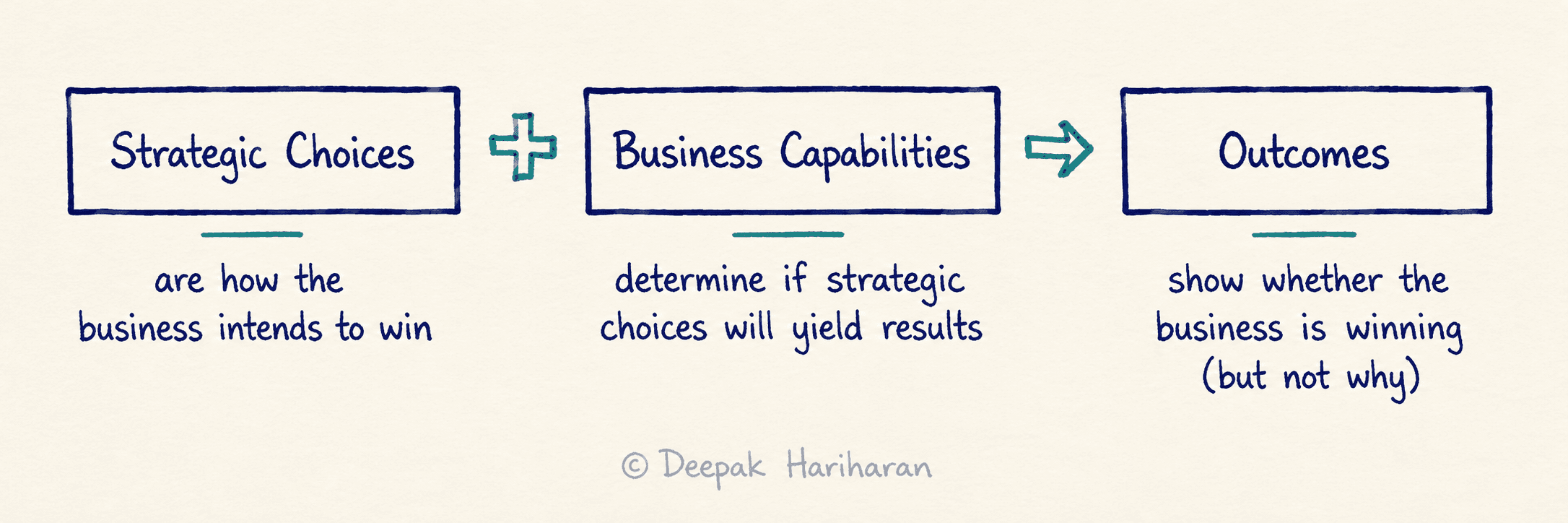
Strategic Choices define how the business intends to win: Customer segment, Problem being solved, Product / solution design, Pricing, Business model, Go-to-market model, Growth Bets and Resource & Capital Allocation priorities.
Business Capabilities determine whether the strategic choices will yield results: Customer Acquisition, Retention / Lifetime value, Delivery / Service, Operating Efficiency, Talent (alignment, empowerment, accountability), Reviews & Course Correction, and Capital Allocation Discipline. Organization Design shapes how Business Capabilities work together at scale.
These Strategic Choices determine the direction of Growth and Profitability. The Business Capabilities determine whether they translate into results.
Outcome Metrics show whether the business is winning, but not why. Commonly tracked outcomes include Revenue, EBITDA, PAT, Cash Flow and ROCE.
Businesses frequently fall short of their desired outcomes. When outcomes fall short, strong leadership teams do not merely increase activity. They revisit the choices and capabilities driving those outcomes.
While diagnosing, it is tempting to treat the visible symptom as the problem - especially under performance pressure.
Revenue slows, so the sales target is increased. Margins fall, so budgets are cut. Execution slips, so more reviews are added. These responses may create activity without addressing the constraint behind the outcome.
Outcome Metrics tell leaders whether the business is winning. Health Metrics help diagnose where the system is working or breaking.
The right Health Metrics are specific to the company, its context and the constraint being examined.
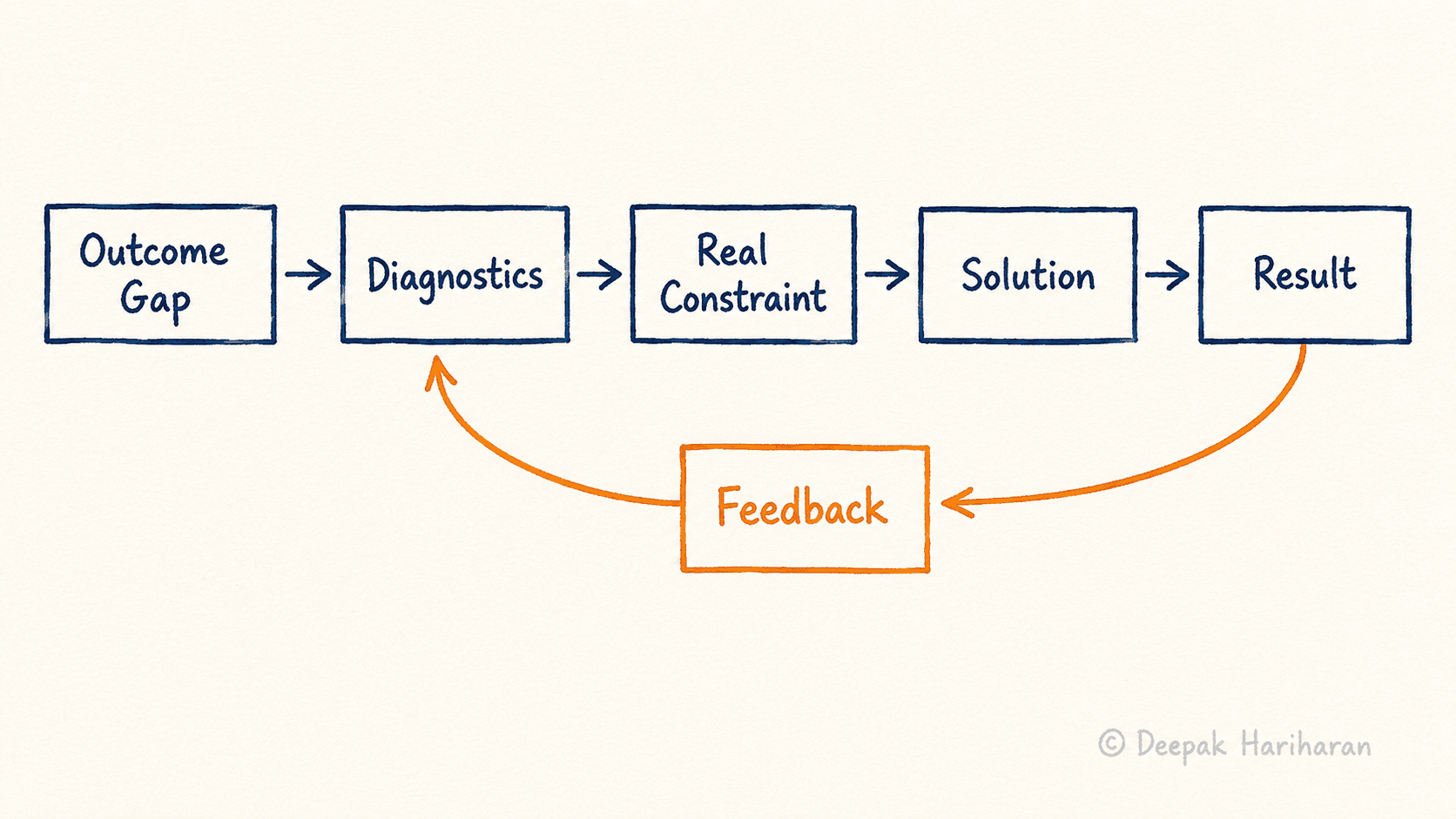
Outcome gap: What is not moving? [Compare actual outcomes with expected outcomes.]
Diagnostics: Where is the system breaking? [Study the Health Metrics.]
Real Constraint: Which choice or capability explains it? [Naming the constraint makes it more solvable.]
Solution: What focused intervention is required? [Focus on the Circle of Influence, not the Circle of Concern.]
Result: Is the outcome improving? [Same as Step 1]
Feedback: Do more of what worked, or diagnose what did not work and repeat. [Repeat steps 2-5.]
For instance, suppose growth has slowed. The first step is not to brainstorm solutions (it is really tempting to jump into trying solutions to accelerate growth - many of us have been there). It is to disaggregate the outcome into Health Metrics such as new-customer growth, existing customer retention, purchase frequency, ticket size.
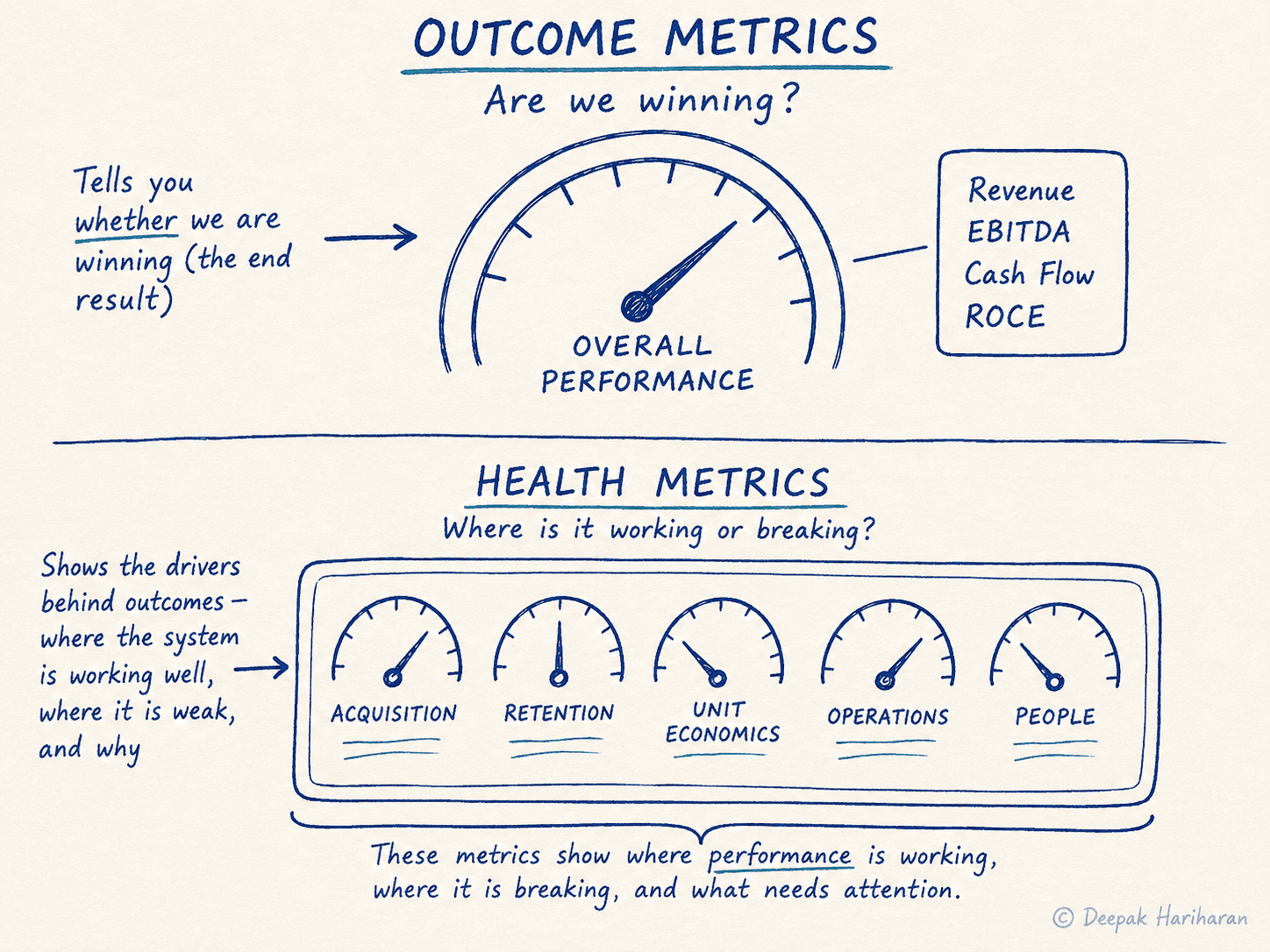
Further relevant cuts by customer cohort, product, channel, and engagement points, reveal what really is underperforming. Then, the strategic choices and capabilities behind that weakness reveal the possible intervention paths. Design the most focused intervention, execute it and track whether the relevant Health Metrics and Outcome Metrics improve. Review the results and course-correct as needed.
Learnings from Experience
When I reflect on nearly two decades spent operating and scaling 0→1 startups, 1→10 ventures and 10→100 institutions, the pattern recurs: the Visible Outcome and the Real Constraint often sit in different places.
A retention problem may begin with acquiring the wrong customers. A people problem may be rooted in organizational design. A profitability problem may originate in customer, product or business-model choices.
These experiences have shaped my thinking across six interconnected themes: Growth, Retention, Profitability, Unit Economics, Operations and Organization. Together, they form my perspective on Profitable Scale.
These are their primary relationships, but all six themes are interconnected. Retention affects Profitability; Operations can strengthen Revenue; and Organization enables every Business Capability.
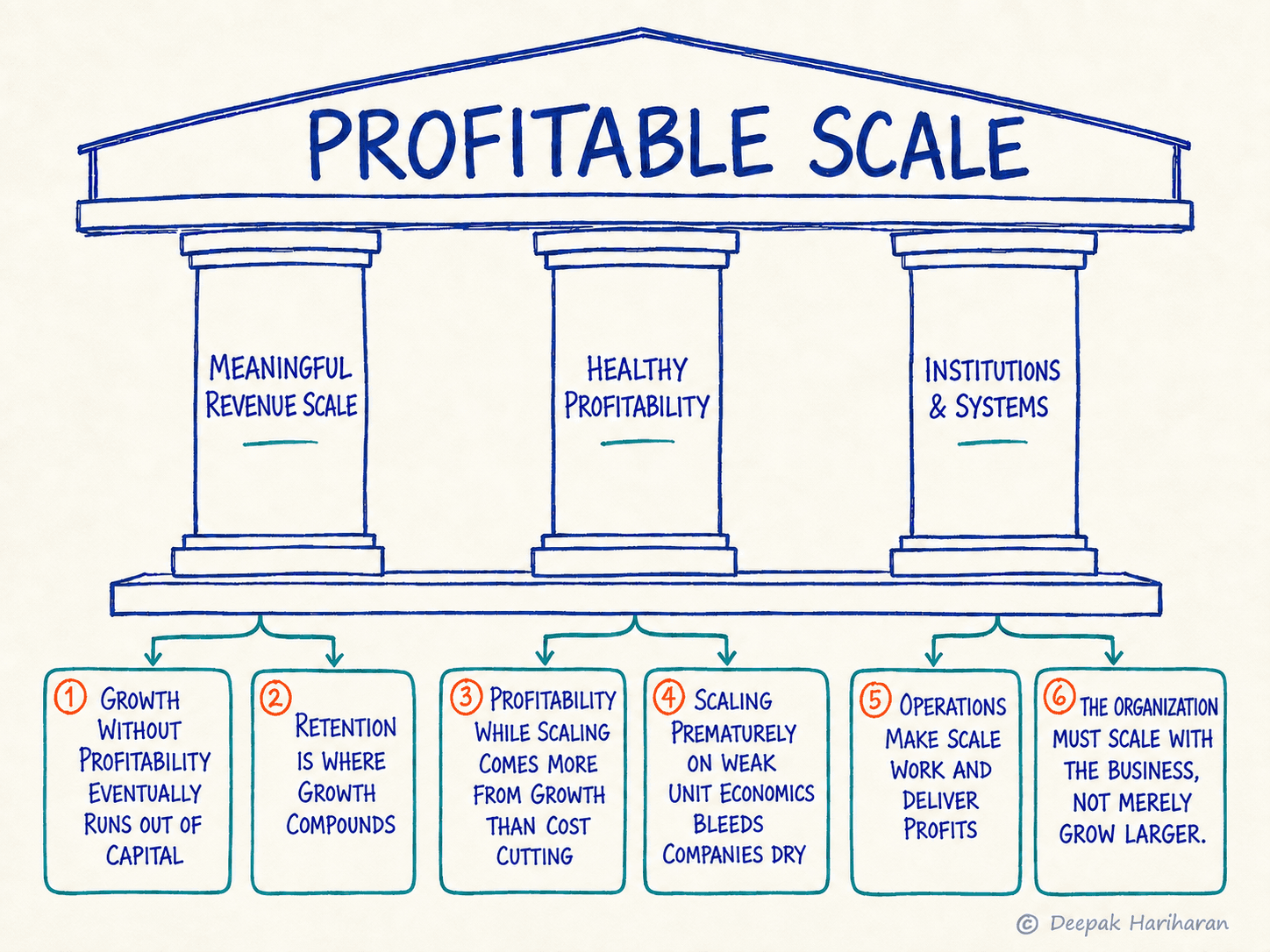
Sharing my learnings as six essays - read them in any order, based on the biggest challenge you see today:
Towards Meaningful Revenue Scale: |
|---|
1 - Growth without Profitability eventually runs out of Capital. |
2 - Retention is where Growth compounds. |
Towards Healthy Profitability: |
|---|
3 - Profitability while Scaling comes more from Growth than Cost Cutting. |
4 - Scaling Prematurely on Weak Unit Economics bleeds companies dry. |
Towards Institutions and Systems: |
|---|
5 - Operations make Scale work and deliver Profits. |
6 - The Organization must Scale with the Business, not merely grow larger. |
Before You Move On
Complete these three sentences:
Our next major goal towards Profitable Scale is _________________.
The Real Constraint holding us back is _________________.
So, I am going to _________________.
If these questions surface an important constraint in your business, I am always open to a thoughtful conversation.