As businesses grow, the organization that enabled early success can become a constraint.
In the early stage, founders and senior leaders carry much of the business context themselves. Roles are broad. Teams coordinate informally. Decisions are taken quickly because the people involved are close to one another, the customer and the problem.
Growth changes this. More people, products, functions, markets and management layers are added. Information gets distributed across the organization. Decisions require coordination across teams. Work that was once handled through direct conversations now needs clearer roles, structures and ways of working.
Without this redesign, confusion begins to grow with the business. Work gets duplicated. Important responsibilities fall between teams. Decisions slow down. Leaders become escalation points. Different functions work hard, but towards different outcomes.
This is often treated as a people-performance problem. Sometimes it is. But often, capable people are operating inside an organization that has not been designed for its current scale.
The key question for a scaling organization is: Are we designed for long-term Profitable Scale?
Organization Design determines how Business Capabilities deliver. The right structure, spans and decision rights create the operating context in which Customer Acquisition, Delivery, Talent and other Business Capabilities can function effectively at scale.
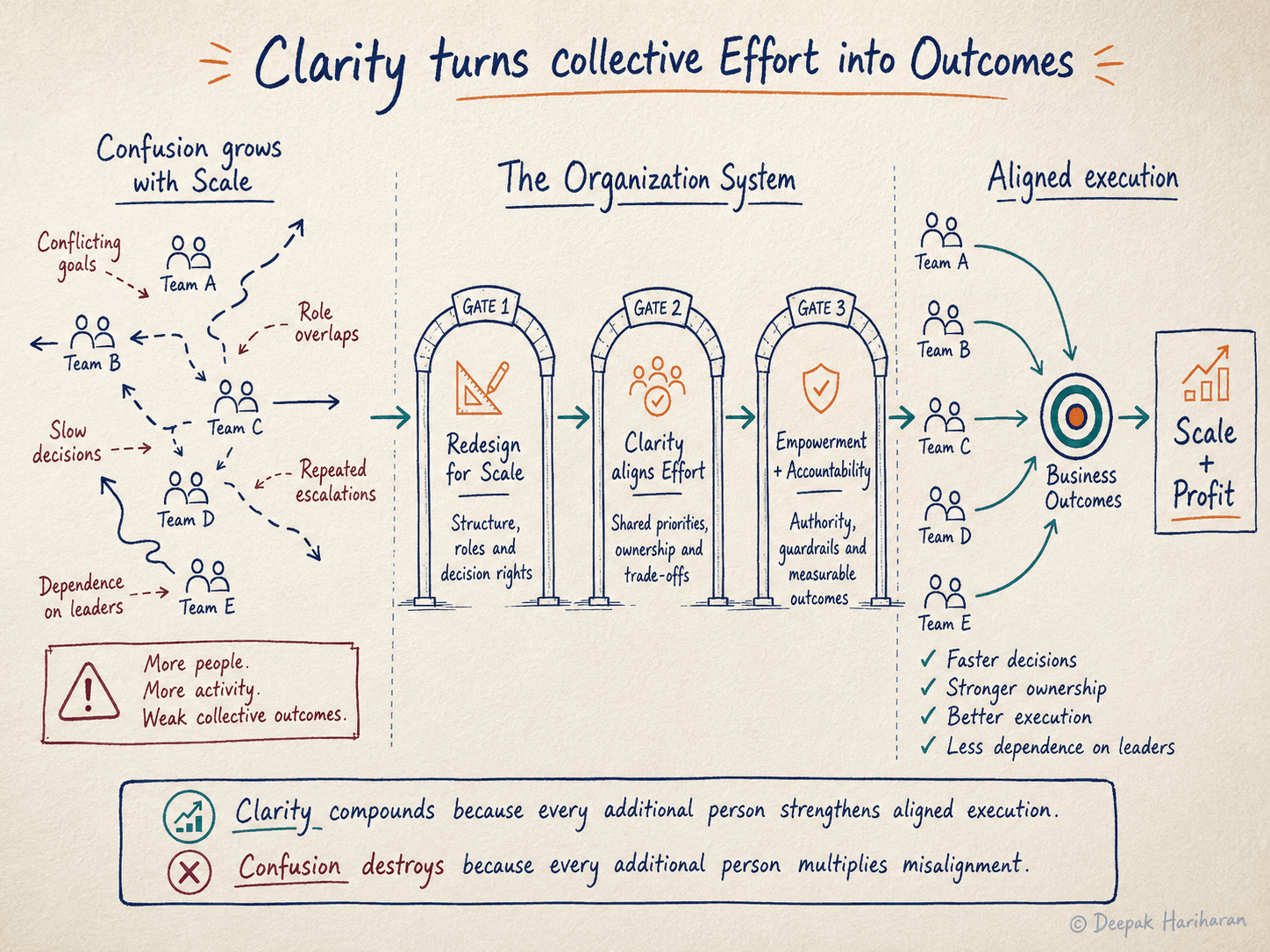
In this article, we will cover three key elements:
Organizations need to be redesigned for Scale - The roles, structures, spans and decision rights that worked earlier need to evolve as the business grows.
Clarity aligns Effort - Business priorities need to translate into clear goals, ownership, responsibilities and trade-offs across teams.
Empowerment and Accountability together drive Success - People need the authority and guardrails to act, along with clear accountability for outcomes.
1 - Organizations need to be redesigned for Scale
In the early stage, organizations are often built around people rather than clearly defined roles.
A strong leader takes on several responsibilities. Teams step across boundaries to solve urgent problems. Founders remain involved in product decisions, customer escalations, hiring, pricing, sales and operations. These overlaps can be useful because the business is still proving its model.
As the company scales, the same flexibility can create confusion.
Multiple people may believe they own the same decision, while other responsibilities have no clear owner. Leaders remain involved in decisions their teams should be taking. New layers are added to manage coordination, but the underlying roles and responsibilities remain unclear.
The organization may have more people, yet still depend on the same few individuals to make the important decisions.
This is why organization design cannot simply be the early-stage structure with more people added to it. The design needs to reflect the Business Model, the Strategic Choices and the scale the business has reached.
There is no single ideal organization structure.
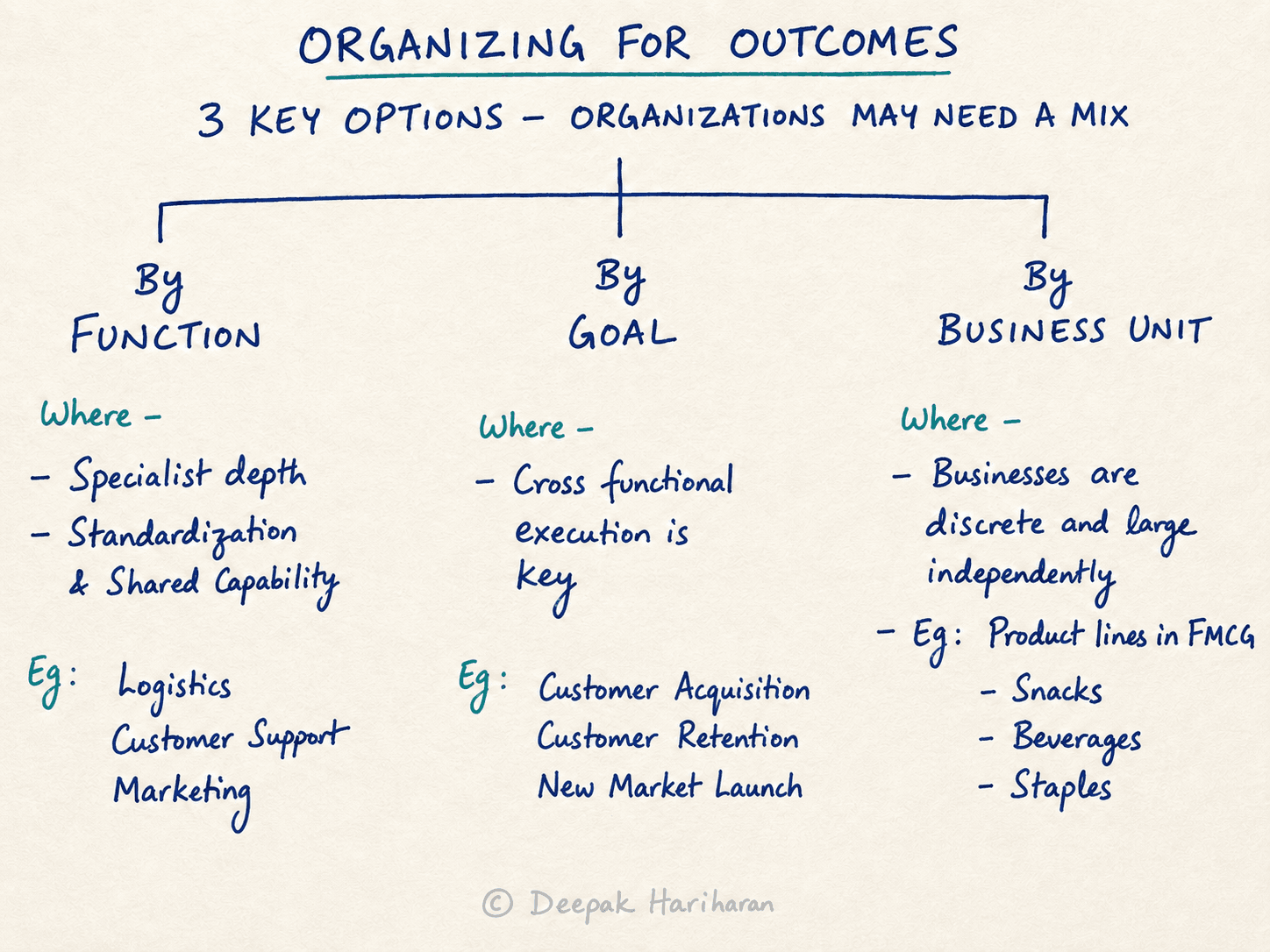
Organizations can be designed primarily by Function, Goal or Business Unit - and many businesses need a thoughtful mix of all three:
A company with one core product may benefit from strong functional teams.
A critical Business Priority that requires close coordination across functions may benefit from a cross-functional team organized around that Goal.
A large company with several distinct products, customer segments or business models may need clearer business-unit ownership.
Some capabilities may need to remain shared, while others may need to sit closer to the individual Business Unit.
The objective is not to keep changing the organization chart. It is to ensure that the structure supports the work that needs to get done.
A good organization design makes ownership and decision-making easier. A weak design creates more meetings, reviews and escalations without solving the underlying confusion.
Organization redesign should therefore start with the Business Outcomes and Strategic Choices, not with boxes and reporting lines.
2 - Clarity aligns Effort
A company may have clear annual goals and still have significant confusion inside the organization.
Revenue, Profitability or Cash Flow targets may be well understood at the leadership level. But these targets often get translated into separate functional goals.
Sales focuses on acquisition. Product focuses on launches and features. Operations focuses on cost and service levels. Finance focuses on budgets. Each team may achieve its own target, while the business misses the larger outcome.
For example,
Sales may bring in customers who do not retain.
Product may launch features that customers do not use.
Operations may reduce costs in ways that weaken the customer experience.
This means that teams may each report progress while Revenue quality or Profitability deteriorates.
Clarity requires more than communicating the company goals.
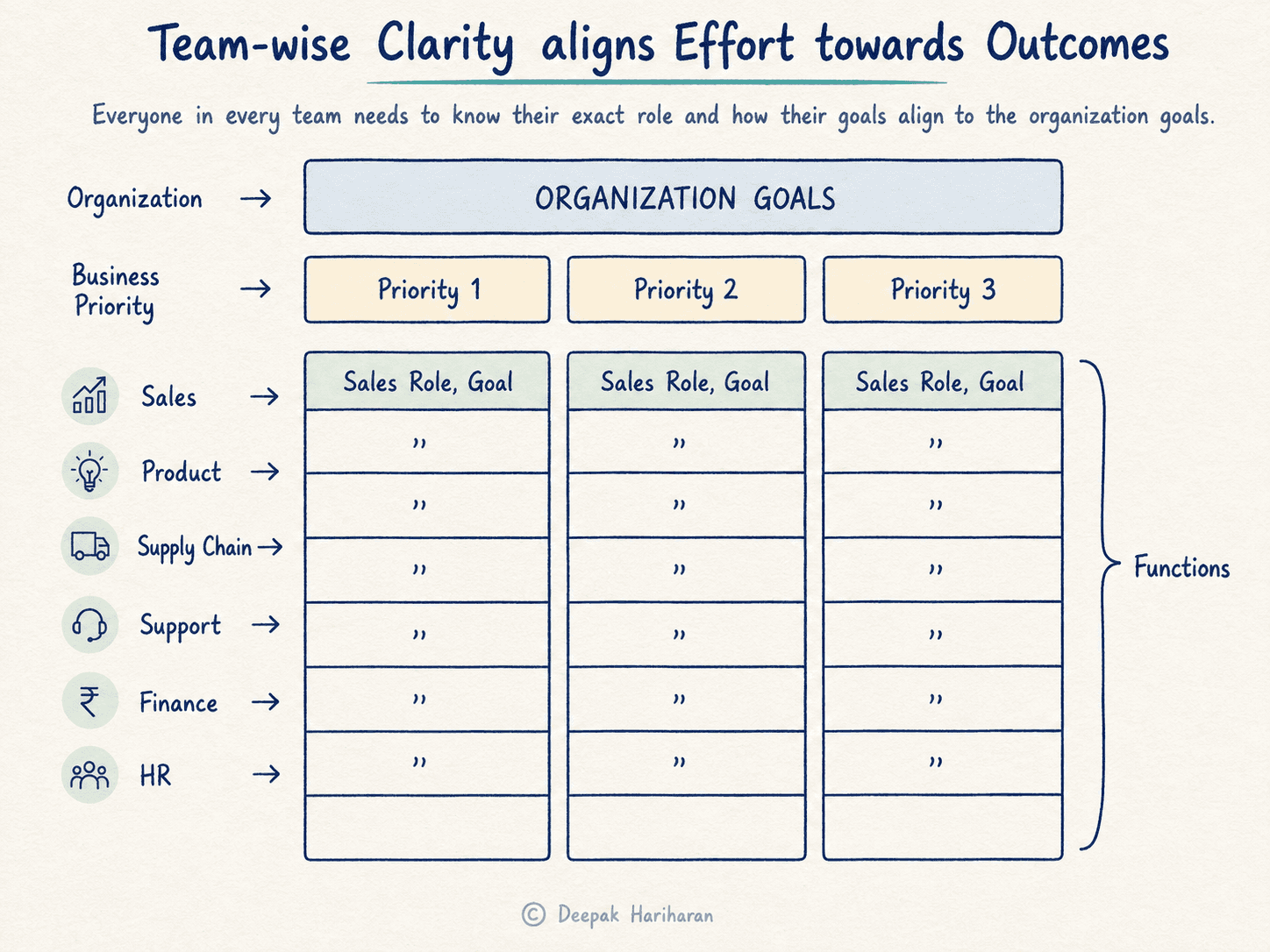
Each major Business Priority needs to translate into:
a clearly defined outcome;
one accountable owner;
the teams that need to contribute;
the decisions each team owns, along with pre-aligned guiding principles;
the trade-offs that have already been agreed;
and the Health Metrics that show whether progress is real.
This becomes especially important when priorities conflict. A company may want faster Growth and better Profitability at the same time. Sales may want greater flexibility in Pricing, while Finance wants tighter controls. Product may want to build for future scale, while the business needs immediate customer solutions.
These tensions cannot be resolved only through functional targets. Leadership needs to make the choices explicit. What matters most now? What trade-offs are we willing to make? What will we not compromise? Who takes the final decision when priorities conflict?
Without this clarity, teams make different assumptions. They protect their own goals, escalate repeatedly or wait for senior leadership to decide.
The cost of confusion increases with scale. More people work on the wrong priorities. The same work is repeated across teams. Decisions get reopened. Leadership time gets consumed in resolving issues that should already have clear ownership.
Clarity reduces this waste. It helps people understand not only what they need to do, but why it matters, how success will be measured and how their work connects to the larger Business Outcome.
This does not require every employee to carry the same goals. But functional goals should connect clearly to shared Business Priorities.
Sales should not be accountable only for acquisition, but also for acquisition quality. Product should not be measured only on releases, but also on adoption and customer value. Operations should not focus only on cost, but also on the quality and reliability of delivery. Leaders need to see the business outcome, not just the functional output.
Clarity compounds because aligned teams make better decisions without repeatedly escalating to senior leadership.
3 - Empowerment and Accountability together drive Success
As businesses scale, senior leaders can no longer take every important decision themselves.
But many organizations continue to operate that way.
Teams are told they are empowered, but important decisions still require several approvals. Leaders intervene frequently because expectations are unclear. Employees avoid taking risks because they do not know which decisions they truly own.
This slows the organization and keeps senior leaders trapped in day-to-day execution.
The opposite situation is also possible. Teams are given freedom, but without clear goals, decision boundaries or review mechanisms. Different teams make inconsistent choices. Problems are identified late. Empowerment becomes an excuse for weak alignment or limited oversight.
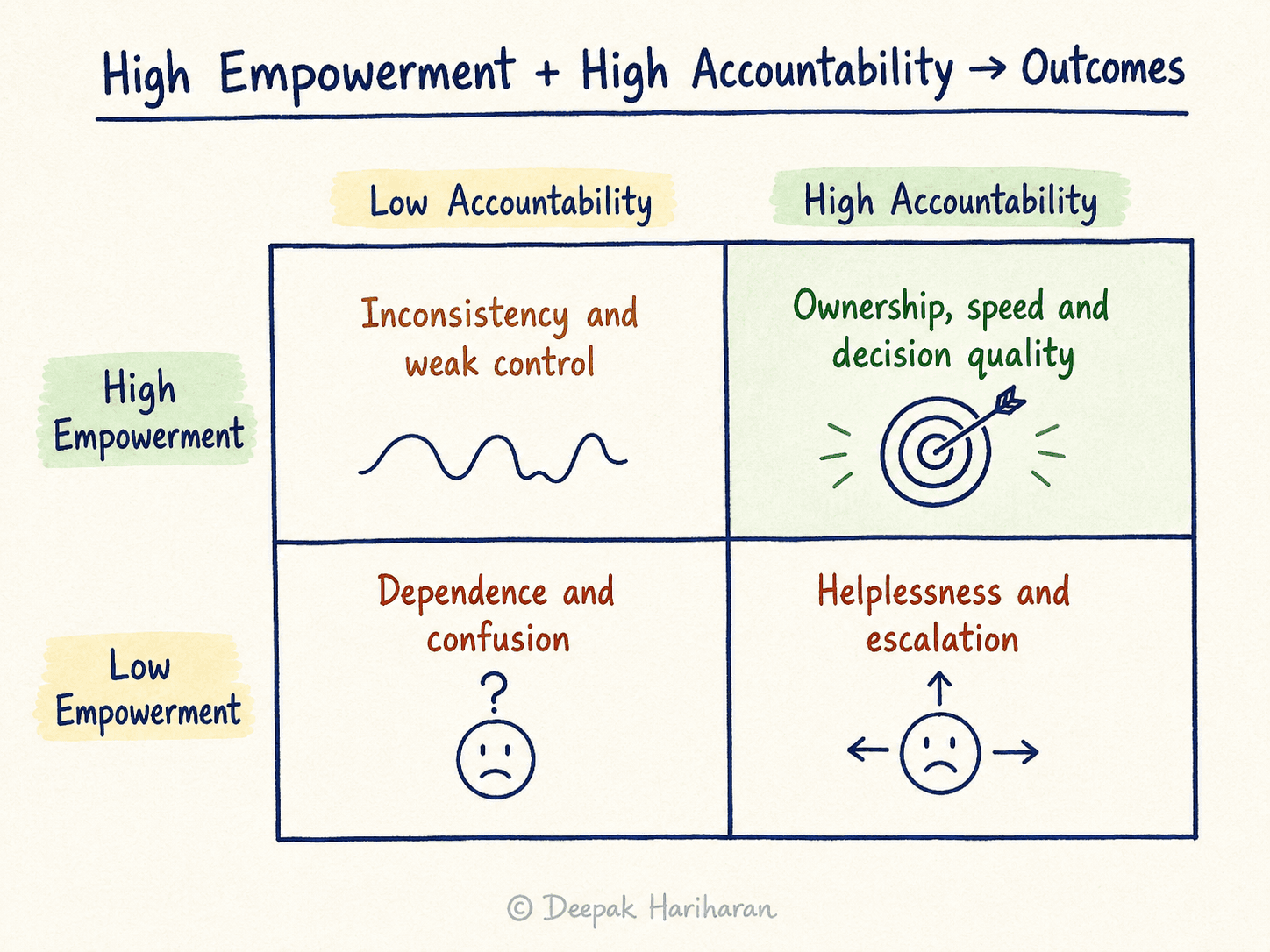
People should know:
Which decisions can I take independently?
What principles or guardrails should guide the decision?
When do I need to consult another team?
At what point should the issue be escalated?
Which outcome am I accountable for?
When these boundaries are clear, decisions can move faster without losing control. Leadership also needs to change its own role.
This does not mean leaders stop getting involved. There are two situations where leaders need to step in:
Leaders should go deeper where the risk is high, the decision is difficult to reverse or the team needs support. But routine decisions should not repeatedly move upward simply because senior leaders hold more context.
Leaders should also step in when a genuinely new problem emerges, help define the solution path and convert the learning into a Playbook. Teams should then be equipped to handle similar situations independently when they recur.
Diagnosing if we are organized right?
Company-level Outcome Metrics such as Revenue, Profitability and Cash Flow may show that execution is falling short, but they do not reveal whether Organization design is helping or holding the business back.
Useful Health Metrics and Diagnostic Indicators may include:
Decision turnaround time,
Frequency of escalation,
Leadership time spent resolving exceptions,
Role overlaps,
Spans of control,
Productivity,
Delivery against shared priorities, and
Attrition in critical roles.
The right measures will depend on the company context and need. The purpose is not to create another organization dashboard. It is to understand where confusion, weak ownership or capability gaps are becoming constraints to Growth and Profitability.
The diagnostic is not intended to label the whole Organization as weak. A good diagnostic should identify the Real Constraint - whether it sits in structure, role clarity, conflicting goals, decision rights, capability gaps or leadership behaviour.
Before You Move On
Complete these four sentences:
Our top business priority that the organization must enable is __________________.
My organization is primarily designed by __________ (Function / Goal / Business Unit). This design is __________ (working well / needs a revisit).
The Real Constraint in our Organization is __________________.
The highest-impact action we will take now is __________________.
If these questions surface an important issue about your organization design, I am always open to a thoughtful conversation.


