Scaling creates visible signs of progress: customer acquisition rises, Revenue grows, the business enters new Markets and teams expand. These milestones can create confidence that the business model is working.
But demand and growth alone do not deliver Profitable Scale. [Read more at Profitable Scale is Designed, not Discovered.] Some common patterns emerge when businesses scale prematurely:
acquiring customers before knowing which segments have healthy contribution and retention;
entering markets before understanding CAC, cost to serve and repeat behaviour;
adding Products or Channels before knowing which combinations create Positive Transaction Economics (Revenue from a transaction exceeding its direct, attributable costs);
adding capacity before there is evidence that utilisation will improve economics.
Scaling up can then increase not only revenue, but also losses, complexity, management effort and capital dependence.
The right question is: Are our Business Economics healthy enough to scale?
In this article, we will cover three key elements:
Unit Economics need to be Measured Right - Tracking the right metrics gives us visibility into what is working and what is not.
Unit Economics drive Strategic Choices - Unit Economics are not metrics only for the CFO. They inform real business decisions and strategy.
Unit Economics should improve with Scale - Unit Economics should improve with volume and density growth - as direct and indirect costs per unit reduce. Tracking whether these benefits are actually emerging—and correcting when they are not—is crucial to the path to Profitability.
1 - Unit Economics need to be Measured Right
Unit Economics help us understand whether the underlying transaction or customer relationship creates value. But the answer depends heavily on how the measurement is done.
Business reporting often relies on averages. Average Revenue, Average Selling Price, Gross Margin, Customer Acquisition Cost or Cost to Serve are useful for company-level reporting, but they are inadequate for diagnosis.

However, averages can hide significant differences across Customer segments, Products, Channels, Markets and Cohorts. Situations like these are more common than expected:
One Customer segment may have a stronger need, retain longer and require less service effort. Another may need repeated discounts, have low usage and leave quickly.
One Channel may appear attractive because of a low CAC, but bring customers with weak retention.
One Product may have a high Gross Margin, but require heavy support and customization after the sale.
The relevant Health Metrics may include Net Revenue, Contribution Margin, Customer Acquisition Cost, Retention, Repeat Revenue, Lifetime Value, Discount dependence, Cost to Serve, Service intensity, Capacity Utilisation and Payback Period. The right measures will depend on the company context and need.
A business does not need reams of data. A slice of the above Health Metrics, combined with the right Unit Economics metrics by Customer segment, Product, Channel, Geography and Cohort, is a good starting point for understanding what is working and what is not.
These Health Metrics do more than show that Unit Economics are weak. They help identify the Real Constraint - whether it sits in Customer choice, Product, Pricing, Channel, Cost to Serve, Geography or the Operating Model.
This visibility helps the business scale what is working, refine what is not, and stop investments where the path to healthy economics remains unclear.
Question - Have you looked at your Unit Economics through this lens? Try it and see whether it reveals something new.
2 - Unit Economics drive Strategic Choices
Unit Economics are not merely finance metrics. They should inform the Strategic Choices of the business.
The analysis may show that one Customer segment has a stronger need and better Lifetime Value, while another creates faster initial growth but weaker economics.
One Product may generate revenue quickly, but another may create better Contribution Margins and Retention.
One Channel may be cheaper, while another produces customers who stay and expand.
These differences should shape choices around who to serve, what to offer, how to price, where to compete, which Channels to use and where to allocate capital and leadership attention.
The first version of a business model is unlikely to get all these choices right. The purpose of the Proving Stage (until the business is ready to scale) is to test and refine them until the business identifies the context in which the economics begin to work.
This may be one Customer segment, one Product-Price combination, one Market or one Channel that works well. The company should build depth there, learn from the customer response and improve the model before spreading itself more widely.
This does not mean the business must remain narrow forever. It means that it should first understand where it has the strongest fit and Positive Transaction Economics, and then earn the right to scale. From there, it can expand into adjacent spaces, refine the Product, Pricing or Proposition, or target a different Customer profile to unlock further Growth.
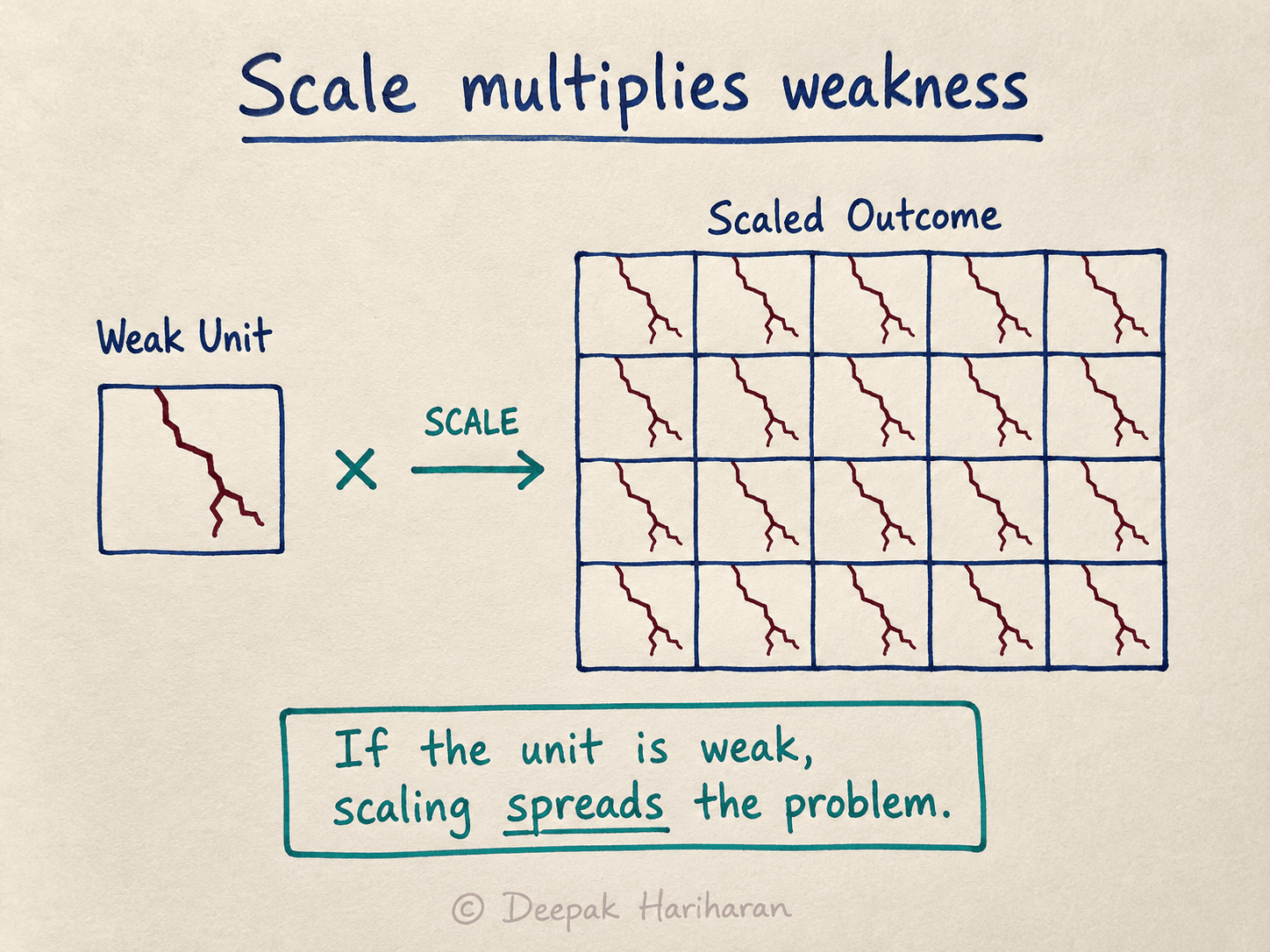
The business sees customer interest and responds by increasing acquisition, entering more markets, expanding the Product portfolio or building capacity. But if the underlying choices are still weak, additional scale multiplies those weaknesses.
Weak Customer choice → higher churn and service costs.
Weak Product → more complaints and customization.
Weak Pricing → higher breakeven volume needed, or a leaky bucket of discounts.
Weak Channel → low-quality acquisition.
Weak Operating Model → more people, controls and coordination.
Scaling up should be for achieving long-term goals, not short term wins.
3 - Unit Economics should improve with Scale
Unit Economics are not always attractive at the start. Some businesses need enough volume, density or utilisation before the full economics become visible. There is a reasonable basis to expect scale benefits - but realising them requires clear goals and tracking:
Procurement costs should improve with larger volumes - have you set goals on COGS for volume slabs?
Service costs and logistics costs should improve with higher density. Is this really happening?
Technology and central teams may support more revenue without much cost increase. Is this the case, or are we scaling up linearly with volume?
Brand, referrals and repeat business should reduce acquisition effort. Is this happening?
Revenue per unit may improve through better Pricing, higher usage, larger ticket sizes, upsell or a stronger Product and Customer mix. Is Scale helping the business capture more value per transaction, Customer or account?
The statement that “Unit Economics will improve with scale” is useful only when the source of improvement is understood and the evidence begins to appear. Otherwise, it can become a reason to continue investing in a model that is not working.
To clarify, scaling up should not be on the hope that unit economics of a fundamentally unsound business “should” improve - there should be strong signals supporting it.
Premature Scaling multiplies Cost and Complexity
The cost and complexity of correction also increase with scale.
Exiting a weak Market becomes harder once teams, offices and infrastructure are in place.
Changing Pricing becomes harder after customers have been trained to expect discounts.
Simplifying the Product becomes harder once multiple teams and processes depend on it.
Reducing capacity becomes harder after fixed costs have been committed.
Management attention also gets spread across a larger system. Leadership spends more time resolving coordination issues, reviewing performance and managing exceptions. The organization becomes increasingly occupied with running the complexity it has created - not on delivering real Profitable Scale.
Takeaway - The business should earn the right to scale
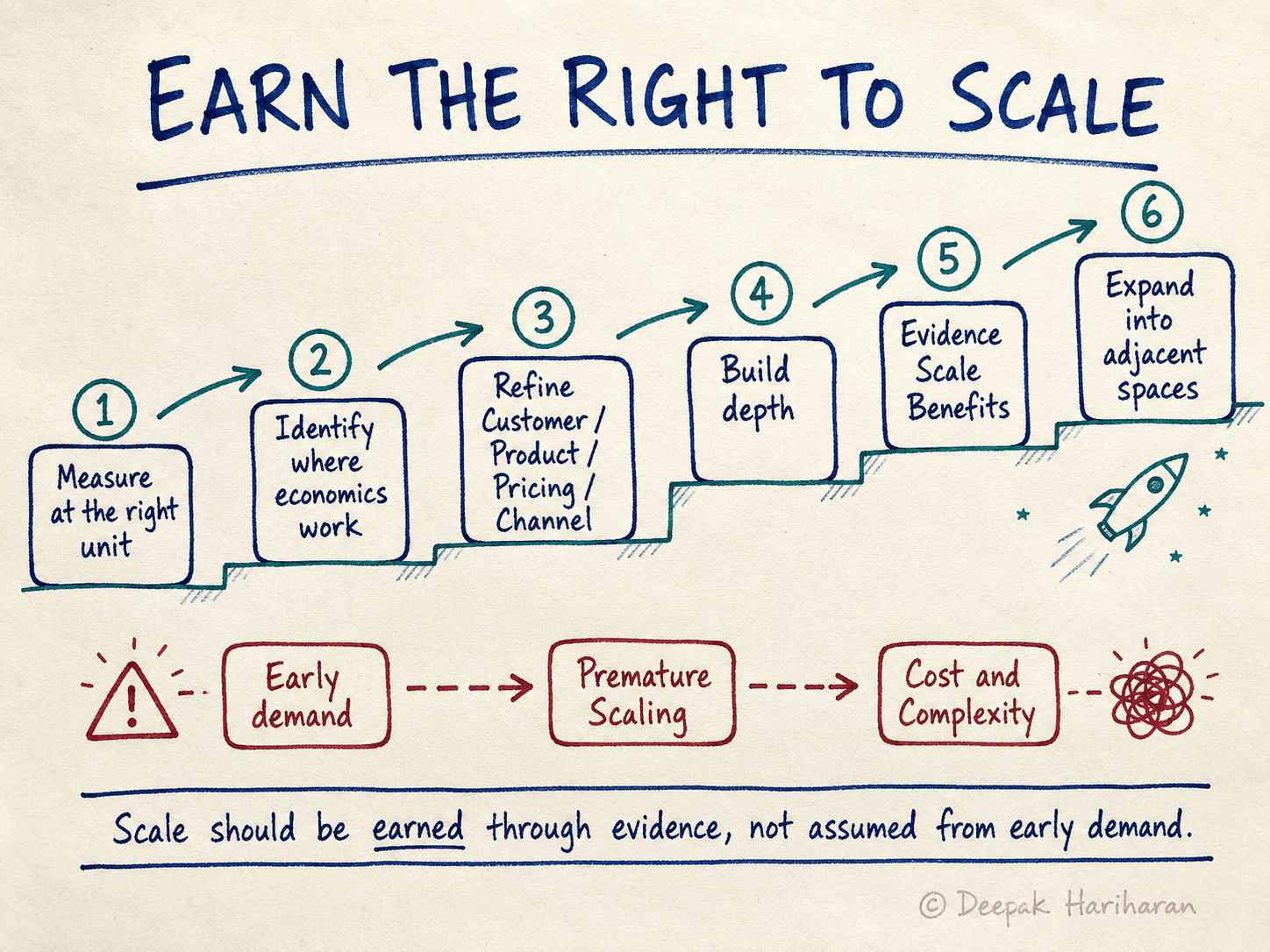
The objective is not to avoid investment or expansion. It is to sequence them after the business has enough clarity on where the economics work and what must improve as volume increases.
Before You Move On
Complete these three sentences:
Our strongest Unit Economics are in __________________ (mention customer profile x Product x market mix).
The Real Constraint weakening our Unit Economics is __________________.
The highest-leverage action we will take now is __________________.
If these questions surface an important issue about Unit Economics in your business, I am always open to a thoughtful conversation.