Growth increases the size of the business. More customers, more transactions, more markets and more Products create the opportunity for scale.
But Growth also adds complexity. Volumes increase. Exceptions multiply. The business enters more geographies. Teams expand and coordination becomes harder. What worked when the business was smaller will rarely work in the same way at scale.
This is where Operations matter.
When Operations remain a secondary priority, the effort and costs required to run the business can increase almost in line with scale. Operations need to be redesigned so that the business can realise the benefits of lower costs, greater productivity, better quality and higher speed that scale should unlock.
The key question for a scaling organization is: Are we efficiently enabling Profitable Scale?
In this article, we will cover four key elements:
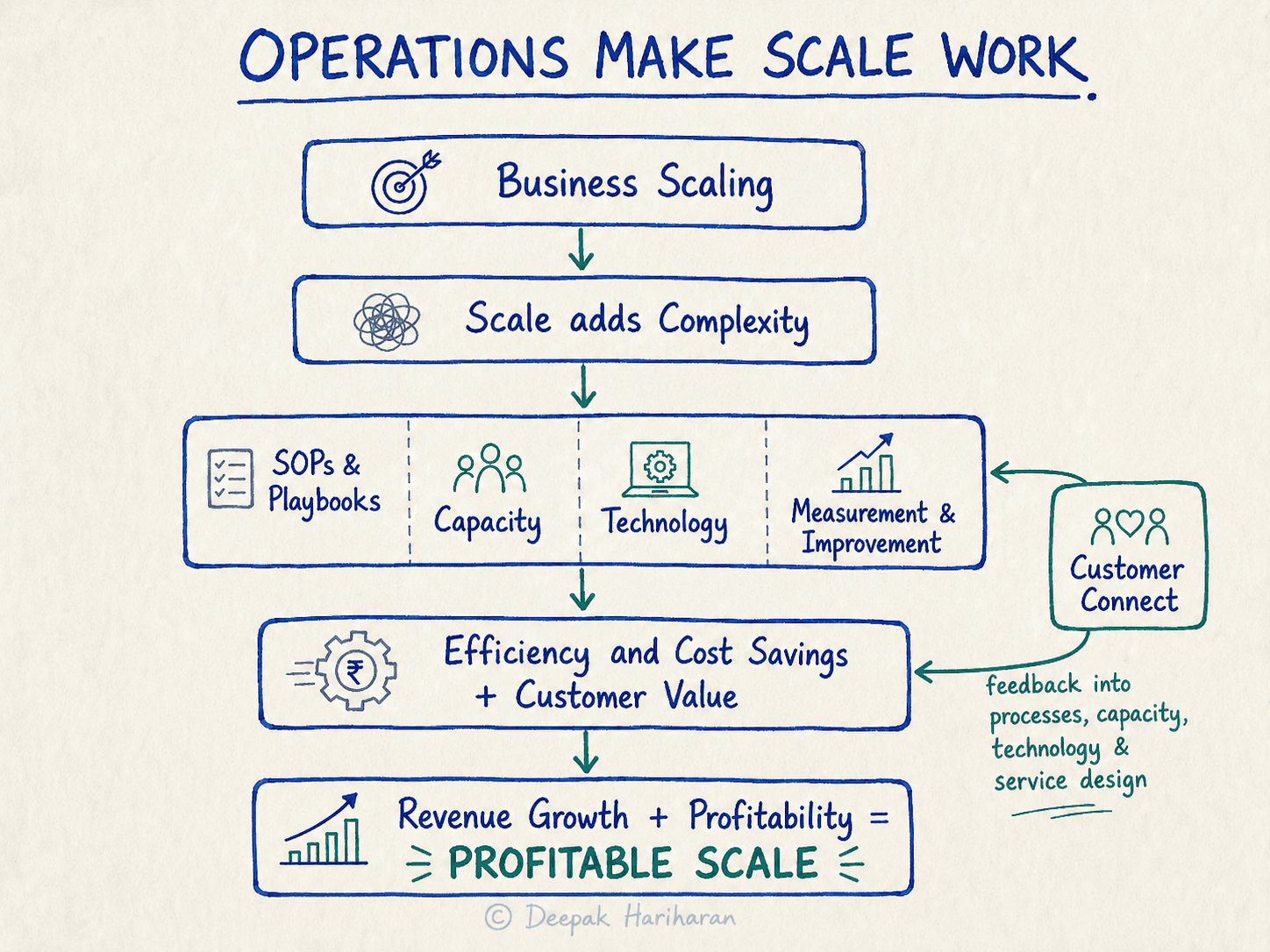
Scale first adds Complexity, and then Efficiency and Cost Savings - As the business grows, the operating model needs to be redesigned. Standardisation, capacity planning, technology, measurement and continuous improvement help the business support more Revenue without costs increasing at the same rate.
Good Operations also drive up Revenue - Operations are often treated only as a cost function. But better availability, delivery, reliability and service can strengthen Customer Value, improve Retention and Referrals, and support Revenue Growth.
Efficiency with Customer Connect yields sustained Profitability - Processes and systems create consistency, but they should not distance leadership from the real Customer Experience. Efficiency that weakens Customer Value will not sustain Profitability.
Operations should be guided by Business Priorities, not standalone - In many organizations, Operations, Sales and Product teams work towards separate priorities and are sometimes in conflict. Operations need to be guided by shared business priorities and trade-offs.
1 - Scale first adds Complexity, and then Efficiency and Cost Savings
In the early stage, experienced people can often hold the business together through direct intervention. Founders and senior leaders stay close to customers. Teams coordinate informally. Exceptions are handled through judgement. Processes remain flexible because the business is still learning.
As volumes grow, these ways of working begin to break. Information no longer moves naturally across the organization. Decisions take longer. Different teams solve the same problem in different ways. Quality varies by person, city, branch or shift. Managers spend more time reviewing activity and resolving exceptions.
The business has grown, but the operating model has not yet been redesigned for scale.
This is why scale first adds complexity. Efficiency and Cost Savings emerge only after the business redesigns how work is done.
That redesign may involve clearer processes, better role definition, stronger capacity planning, more suitable technology, simpler decision rights and greater standardisation. Some activities may need automation. Others may need specialisation. Some teams may need to be consolidated, while others may need to move closer to the customer. [Read More on Organization Design for Profitable Scale.]
The question is not only, “How do we handle more volume?” It is also, “What must work differently at this scale?”
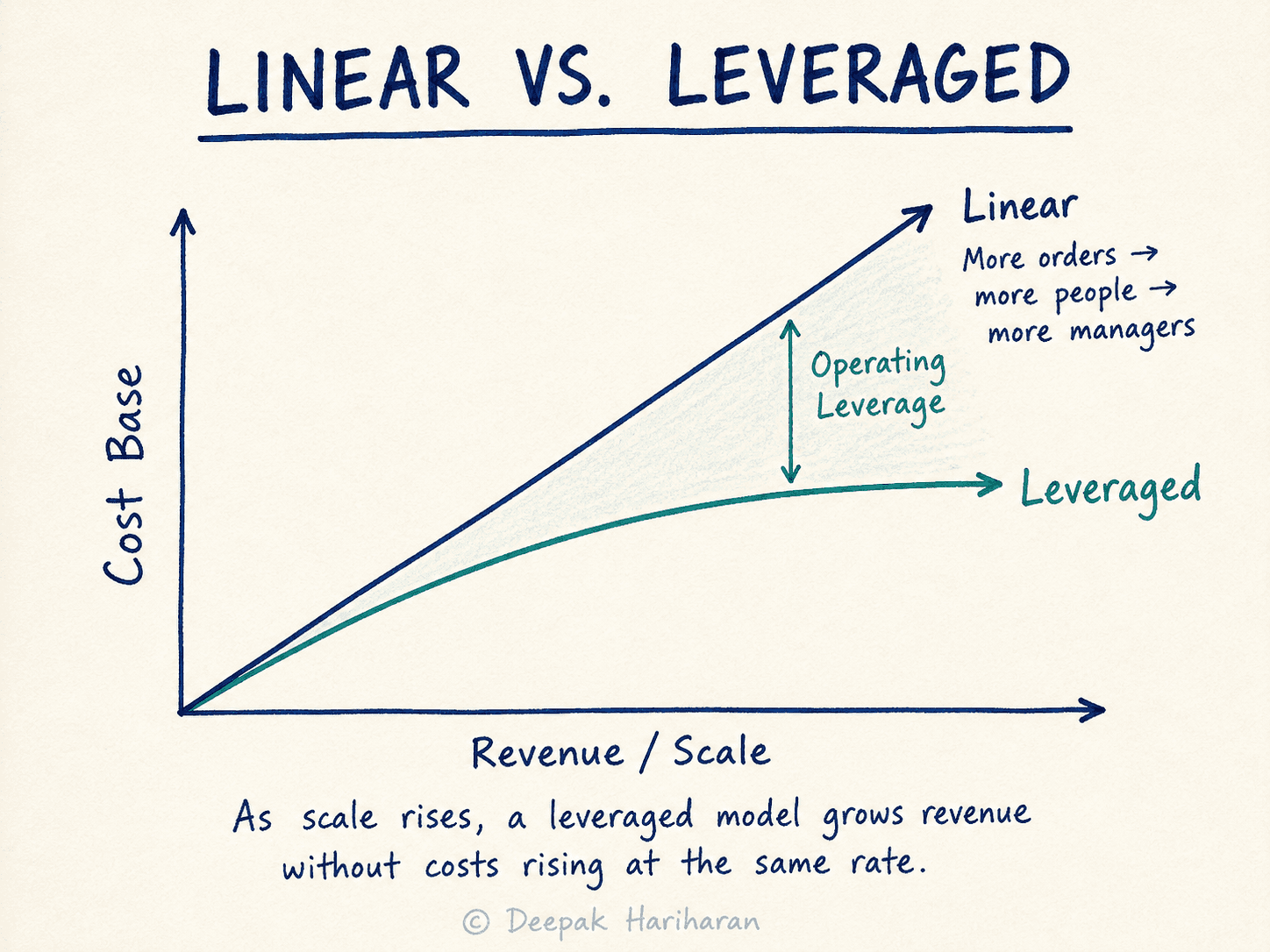
The financial benefit of scale appears when the business can support additional revenue without operations costs increasing at the same rate. But this does not happen automatically.
A business may grow revenue while its operations costs rise almost linearly. More orders require more people. More customers require more support. More cities require more local teams. More complexity creates more managers and reviews. In this situation, the company is growing in activity, but not yet in efficiency.
Operations convert Scale into Profit when repeated work becomes more reliable; capacity is used better; technology reduces manual effort; and the business keeps measuring, learning and improving. Let’s delve deeper.
First, SOPs and Playbooks should standardise repetitive tasks. This reduces repeated decision-making and makes expectations clearer. Leaders define the process, set expectations and enable teams to execute consistently. Employees know what needs to be done, while continuing to use judgement where it adds real value.
Second, good capacity planning improves efficiency with scale. Many businesses add people, locations, inventory or service capacity only after pressure builds. Better planning helps the company understand demand, utilisation and bottlenecks earlier. Too much capacity increases cost, while too little damages service and Customer Experience.
Third, automation can reduce cost, but business teams need to simplify the process first. Technology and Systems can help the business support more volume without increasing people and effort proportionately. Too often, business teams do not prioritise automation, while technology teams are expected to automate processes they do not fully understand. Digitising a weak process often makes the same inefficiency faster. The process should first be understood and simplified, and then supported by the right tools and systems.
Fourth, Operations need to keep measuring, learning and evolving. Outcome Metrics such as Revenue, EBITDA, Cash Flow and ROCE show whether the business is benefiting from scale, but they do not explain whether Operations are improving. Relevant Health Metrics may include productivity, utilisation, turnaround time, quality, error rates, service levels, cost per transaction, Cost to Serve and customer complaints. These measures help the business understand where the operating system is working, where it is breaking and what needs to change.
Operations often present several improvement opportunities - sometimes too many. Leadership needs to identify the few that can materially improve customer value (quality, experience, speed - more in next section) or reduce cost rather than spreading teams across too many small initiatives.
2 - Good Operations also drive up Revenue
Operations are often treated primarily as a cost function. That is too narrow. Good Operations improve cost efficiency, but they should also improve Customer Value and the Customer Experience.
Faster delivery, better availability, fewer errors, reliable service and quicker resolution all create Customer Value. In many businesses, these outcomes directly influence Retention, Referrals and willingness to pay.
Cost efficiency and Customer Value are not always in conflict:
Reducing rework can lower cost and improve quality.
Better capacity planning can improve utilisation and service levels.
Stronger technology can reduce manual effort and make the customer journey easier.
Clear processes can reduce variation and improve trust.
In some businesses, Operations can become an important part of the Value Proposition itself.
Quick question: Do you view Operations as a cost centre or as a Revenue driver?
3 - Efficiency with Customer Connect yields sustained Profitability
As companies scale, leadership naturally moves further away from the customer.
Customer feedback increasingly comes through dashboards, support tickets, account reviews, survey scores and management summaries. These are useful, but they are filtered.
A metric may show that service levels are improving while customers still experience friction. Complaints may reduce because customers have stopped trying to resolve the issue. A process may meet internal targets but create unnecessary effort for the customer.
This is why Standardisation should not reduce Customer Connect.
Leaders need direct exposure to how customers discover, buy, use, renew and seek support from the business. This does not mean bypassing teams or personally solving individual complaints. It means staying close enough to understand whether the operating system is delivering the intended value.
How? A practical way is for senior leaders to spend at least 8–10 hours every month directly with customers across the value journey. This may include customer visits, sales calls, service interactions, usage observation or structured conversations with retained and lost customers. Leaders often see patterns that operators cannot.
The purpose is not to replace data with anecdotes. It is to combine direct customer understanding with operational metrics. When the two do not match, the difference is usually worth investigating.
Customer Connect also helps the business identify when the operating model needs to evolve. Processes that worked at one stage may become less relevant as customer expectations, Products or Channels change.
4 - Operations should be guided by Business Priorities, not standalone
In many organizations, Sales, Product and Operations teams work as separate functions - and are sometimes in conflict. Sales pushes for faster Growth, Product pushes for new features and offerings, while Operations focuses on cost, control and service levels.
Each function may be doing its job well, but the business can still underperform if the teams are optimizing for different outcomes.
This is why Operations should not be tracked only through standalone functional metrics. Productivity, turnaround time, utilisation, quality, complaints and cost per transaction are useful Health Metrics, but they need to be connected to the larger business objective.
Higher productivity is not useful if customer complaints rise. Lower Cost to Serve is not progress if Retention weakens. Faster Growth can destroy value if Operations cannot deliver the promised Customer Experience.
Sales, Product and Operations should therefore work towards shared business goals, make trade-offs together and align their priorities. Operations is not a support function that responds after business strategy has been decided. It is one of the capabilities through which that strategy is delivered - and, done well, one of the Institutions and Systems that enable the business to keep performing without depending on any one leader or team. [Read More: The Right Organization Design helps align teams to the Business Priorities structurally.]
Outcome Metrics show whether the business is benefiting from scale. Operational Health Metrics show where performance is strengthening or breaking. A good diagnostic connects the business outcome to the relevant operational Health Metric and identifies the Real Constraint - whether it sits in process design, capacity, technology, measurement or the priorities guiding Operations.
Before You Move On
Complete these three sentences:
Our top priority for Operations is to __________________.
The Real Constraint holding Operations back from enabling this priority is __________________.
The highest-leverage action we will take now is __________________.
If these questions surface an important issue about Operations in your business, I am always open to a thoughtful conversation.