Profitability is often treated as the outcome that comes after growth.
The assumption is simple: first build scale, then improve margins, and finally cut costs to become profitable.
That sequence may sometimes be necessary. A business may need to invest ahead of revenue in product, technology, talent, market development and capacity. But profitability cannot remain an indefinite future outcome. The business must begin to show how growth will improve its economics.
This is where many scaling businesses struggle. Revenue grows, but losses grow with it. Costs rise almost in proportion to revenue. New markets add complexity. Larger teams create more coordination. The business is scaling in size, but not yet in profitability.
The important question is: Is Profitability scaling faster than Revenue?

In this article, we will cover three key elements:
1 - Get Transaction Economics right before Scaling Up - The underlying transaction or customer relationship must begin to create value before significant capital is committed to scale.
2 - Convert Scale into Profit - Growth should improve acquisition efficiency, Retention, Pricing, Revenue mix, capacity utilisation and the absorption of shared costs. Not all Revenue contributes equally to Profitability.
3 - Profitability comes more from Growth than Cost Cutting - Cost discipline matters, but durable Profitability comes from stronger Growth economics rather than reducing costs alone.
We will then look at the Outcome Metrics and Health Metrics that show whether Profitability is actually scaling.
Before we get there, let's look more closely at the economic health of an organization.
Three levels of Economic Health
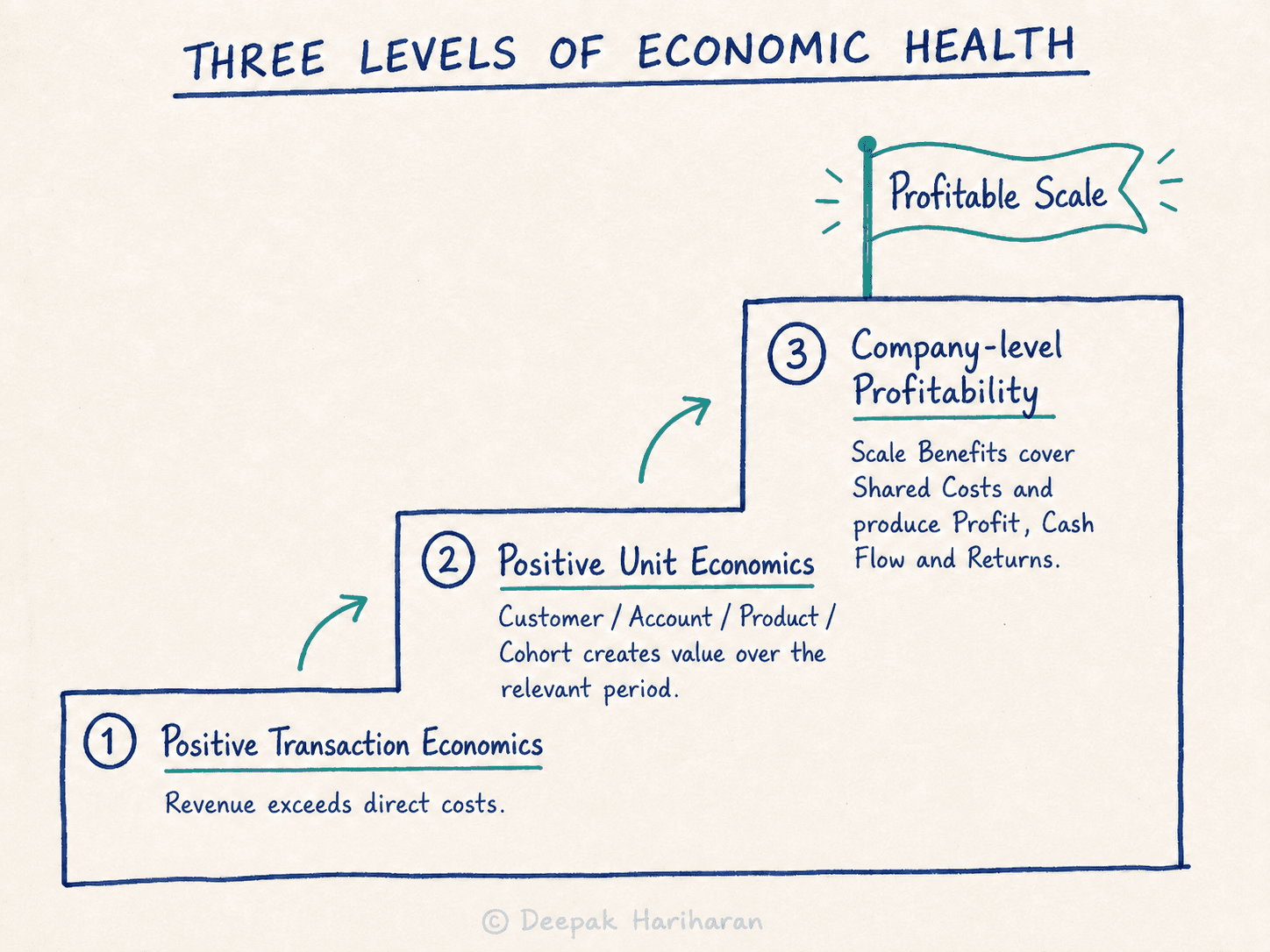
1. Positive Transaction Economics - The net Revenue from the underlying transaction or customer relationship exceeds the direct and attributable costs of delivering that value in a meaningful context. This provides important evidence that the core model can work, but does not by itself prove Product-Market Fit or company-level Profitability.
2. Positive Unit Economics - The appropriate economic unit - such as a customer, account, product, or cohort - creates value over the relevant period after considering acquisition, delivery and servicing costs. This helps identify where the business has earned the right to scale.
3. Company-level Profitability - Positive Unit Economics, together with Scale Benefits, are sufficient to support the shared and indirect cost base of the business and generate sustainable Profit, Cash Flow and Returns.
1 - Get Transaction Economics right before Scaling Up
A business need not be profitable at the company level in its early stages. But the underlying transaction or customer relationship must begin to work.
The destination of the Proving Stage, before committing significant capital to scale, is Positive Transaction Economics. At its simplest, the net revenue from a transaction should exceed the direct and attributable costs of delivering that value. Depending on the business, these may include procurement, inventory, logistics, fulfilment and service costs.
(Some costs, such as central investments, technology development and leadership, may be spread across a larger revenue base as the company scales. Customer Acquisition Cost should be assessed over the expected customer relationship rather than against the first transaction alone.)
If every transaction loses money, scale increases the size of the problem. More customers create more revenue, but also more losses, service requirements and capital dependence.
This is why Positive Transaction Economics is the foundation for Profitable Scale.
A deeper review of Unit Economics can reveal which Strategic Choices need correction before scaling further - Customer segments, Product, Pricing, Go-to-market model or Resource and Capital Allocation. Read more here.
2 - Convert Scale into Profit
Once the underlying model begins to work, growth should improve profitability.
This does not happen automatically. Scale brings advantages, but it also brings complexity. Volumes increase. Teams grow larger. More systems, managers and controls get added. The business enters new markets and serves more varied customers. If these changes are not designed well, the company can grow substantially without creating operating leverage.
Profitable Scale requires revenue to grow faster than the cost base needed to support it. This can happen when:
customer acquisition becomes more efficient as the brand strengthens and channels mature;
retention improves and more revenue comes from existing customers;
pricing strengthens as willingness to pay improves (discounts reduce);
product and customer mix shift towards stronger profit pools;
procurement, capacity utilisation and technology reduce the cost of serving additional demand; and
shared business capabilities lead to cost distribution over a larger revenue base.
Building the Right Organization and Operations Capability helps deliver the outcomes.
Not all Revenue contributes equally to Profitability
Aggregate revenue can hide large differences in economic quality.
Two customer segments may generate similar revenue but very different contribution margins. One product may have a high gross margin but require heavy support. One market may appear large but need discounts, local teams and additional infrastructure. Another may be smaller but retain better and use existing capabilities more efficiently.
Profitability therefore depends not only on how much the business grows, but also on where that growth comes from.
Leadership needs to understand the profit pools within the business:
Which customers create the strongest contribution over time?
Which products improve margins as volumes grow?
Which channels acquire customers who stay?
Which markets create density and operating leverage?
Which parts of the business consume disproportionate capital and leadership attention?
The business should invest more resources in areas where Customer Value, economics and capabilities reinforce one another. Areas with weak economics may need a change in Pricing, Proposition, Operating Model or strategic role. Some may need to be reduced or exited.
3 - Profitability comes more from Growth than Cost Cutting
When profitability falls behind the plan, the first response is often cost reduction. This is understandable.
As companies scale, costs often accumulate gradually. Teams expand before roles are clear. Temporary workarounds become permanent. Multiple tools and vendors serve the same need. New management layers are added without simplifying decisions. Budgets continue because they existed in the previous year.
Cost discipline is necessary. Cost reduction is the right response when excess cost is the Real Constraint. Costs are visible, measurable and usually within management control. Hiring can be slowed. Budgets can be reduced. Vendors can be renegotiated. Teams can be consolidated.
But cost cutting has limits. It can protect cash and correct an inflated cost base. It cannot create a strong economic model by itself. It is not enough when the Real Constraint sits in Customer, Product, Pricing, Market or Business Model choices.
Once obvious waste and excess are removed, further cuts begin to affect Customer Value, Business Capabilities and future growth. Service quality falls. Product development slows. Teams become overstretched. Strong people leave. Leadership attention shifts from building the business to managing scarcity.
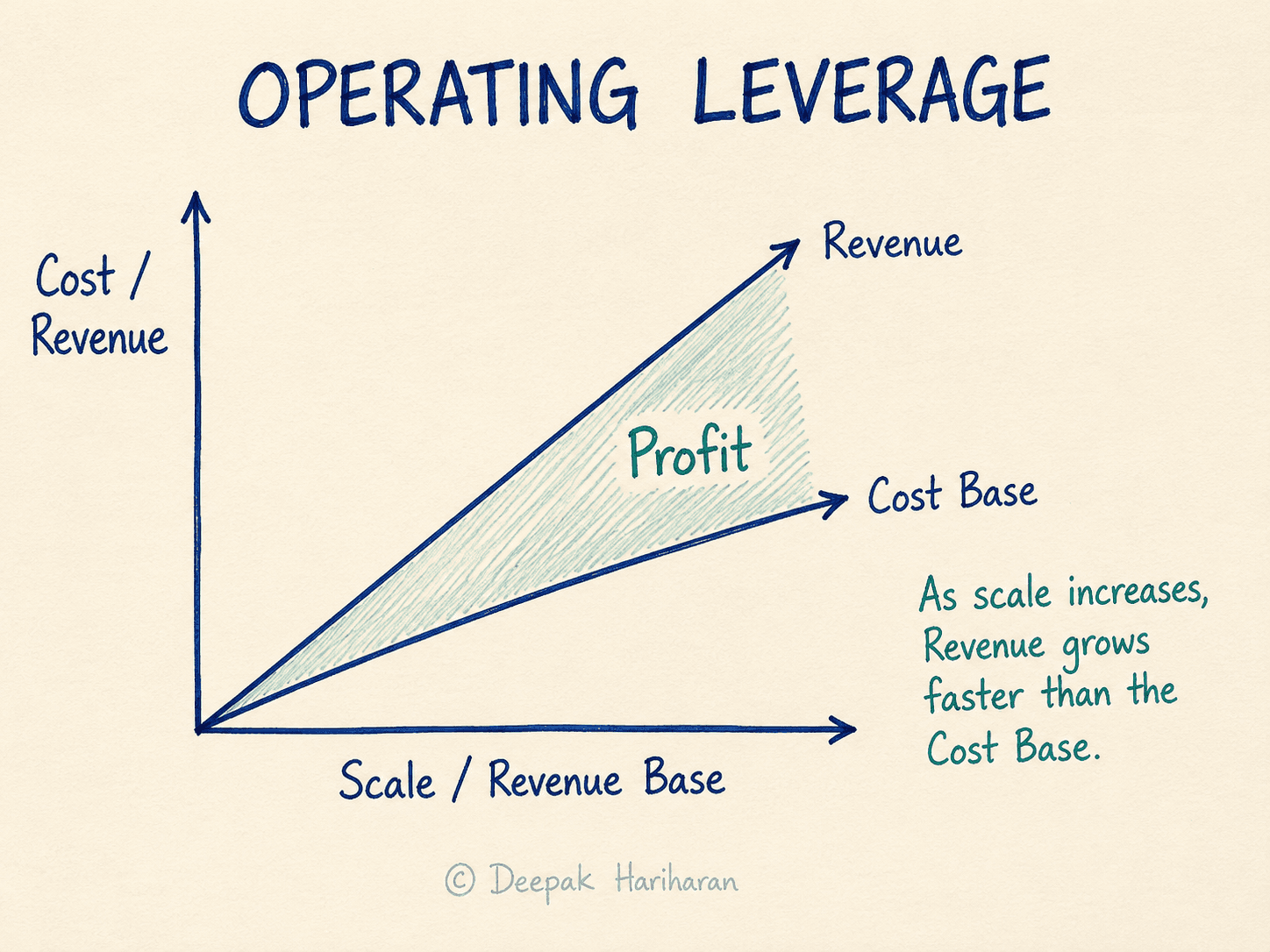
Durable profitability comes more from improving the quality and economics of growth than from reducing costs alone.
As the business scales, this higher-quality revenue should improve contribution and absorb a greater share of the cost base.
Measuring whether Profitability is Scaling
Company-level profitability should be reviewed through both Outcome Metrics and Health Metrics.
Outcome Metrics such as EBITDA, PAT, Cash Flow and ROCE show whether the business is creating financial value. But they do not explain why profitability is improving or weakening.
Health Metrics help diagnose what is happening underneath. These may include Contribution Margin by Customer, Product, Channel or Market; Retention and Repeat Revenue; Pricing and Discount levels; Acquisition Efficiency; Capacity Utilisation; Productivity; Service Cost; and Operating Expense as a percentage of Revenue.
The right measures will depend on the company context and need. The purpose is to understand whether growth is improving economics and whether the resource allocations are creating enough capability and operating leverage.
The diagnostic should identify whether the Real Constraint sits in Transaction Economics, Revenue mix, missing Scale Benefits, Resource Allocation or an inflated cost base. The chosen intervention should then be judged by whether the relevant Health Metrics improve and the Outcome Metrics follow.
Before You Move On
Complete these three sentences:
Our next profitability milestone is __________________.
The Real Constraint preventing Profitability from scaling is __________________.
The highest-leverage action we will take now is __________________.
If these questions surface an important issue about profitability in your business, I am always open to a thoughtful conversation.