Acquisition is visible. Retention is quieter.
New customers, new revenue and new markets create momentum and are easy to celebrate. Retention shows up over time - when customers return, buy more, pay more, refer others and become easier to serve.
That is why Retention is often treated as a supporting metric for Growth. It should not be.
A business that acquires customers but does not retain value is constantly rebuilding the same revenue base. A business that retains and expands customer value starts each period from a stronger foundation than the last.
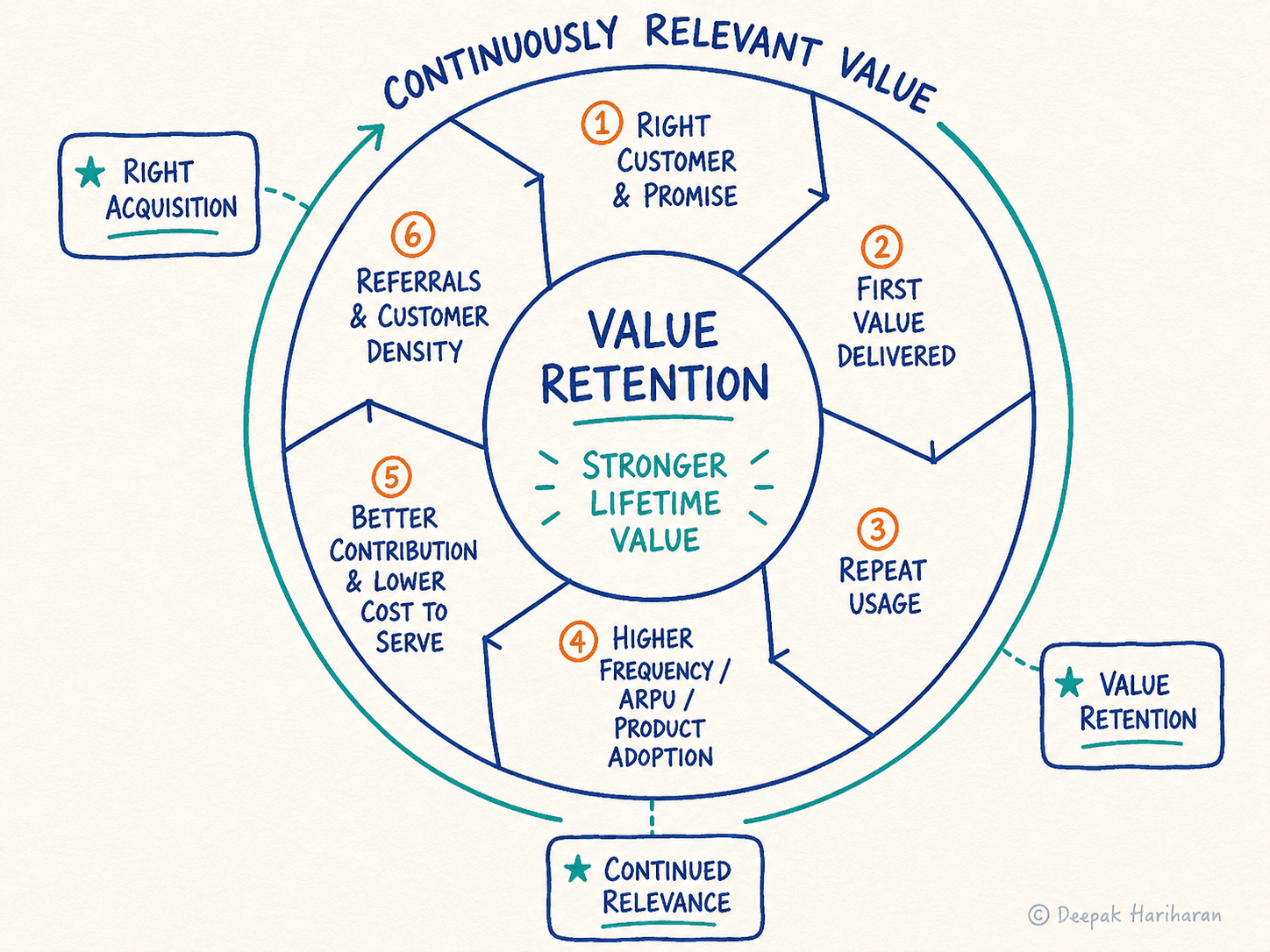
The more useful question is: Are we creating enough value to retain and scale up customer business?
In this article, we will cover four key elements:
1 - Retention is Value Retention, not only Customer Retention - Retained customers should ideally become more valuable through frequency, ticket size, margins, additional products / service upsell, referrals or lower Cost to Serve.
2 - Right Acquisition drives Retention - Customer choice, the initial promise, pricing and channel shape retention even before the first transaction is complete.
3 - Continuously relevant Value drives Retention - Customers stay only while the business continues to solve their iimportant problem and deliver enough value.
4 - Retention is a full-organization priority - Retention is the outcome of several Strategic Choices and Business Capabilities working together. Every team plays a key role in driving retention.
We will then look at how to measure Retention for diagnosis and why Retention must be treated as a full-organization priority.
1 - Retention is Value Retention
Retention is often discussed too narrowly as Customer Retention: did the customer stay or leave?
That matters, but it is only the starting point. A retained customer should ideally become more valuable over time. That may come through higher transaction frequency, larger ticket size or ARPU, better contribution margins, purchase of additional products and services, or referrals.
This is why Lifetime Value matters. But Lifetime Value should be based on actual customer behaviour, not on an optimistic spreadsheet assumption. It should be visible in repeat usage, ticket size, margins, tenure and referrals.
At scale, retention also creates benefits beyond the individual customer. Greater customer density can improve delivery routes, sales productivity, service utilisation, local brand awareness, referrals and support efficiency. A retained customer base can therefore improve both revenue quality and cost economics.This is where retention begins to compound.
2 - Right Acquisition drives Retention
Retention does not begin after the sale. It begins with the choice of customer, promise and channel.
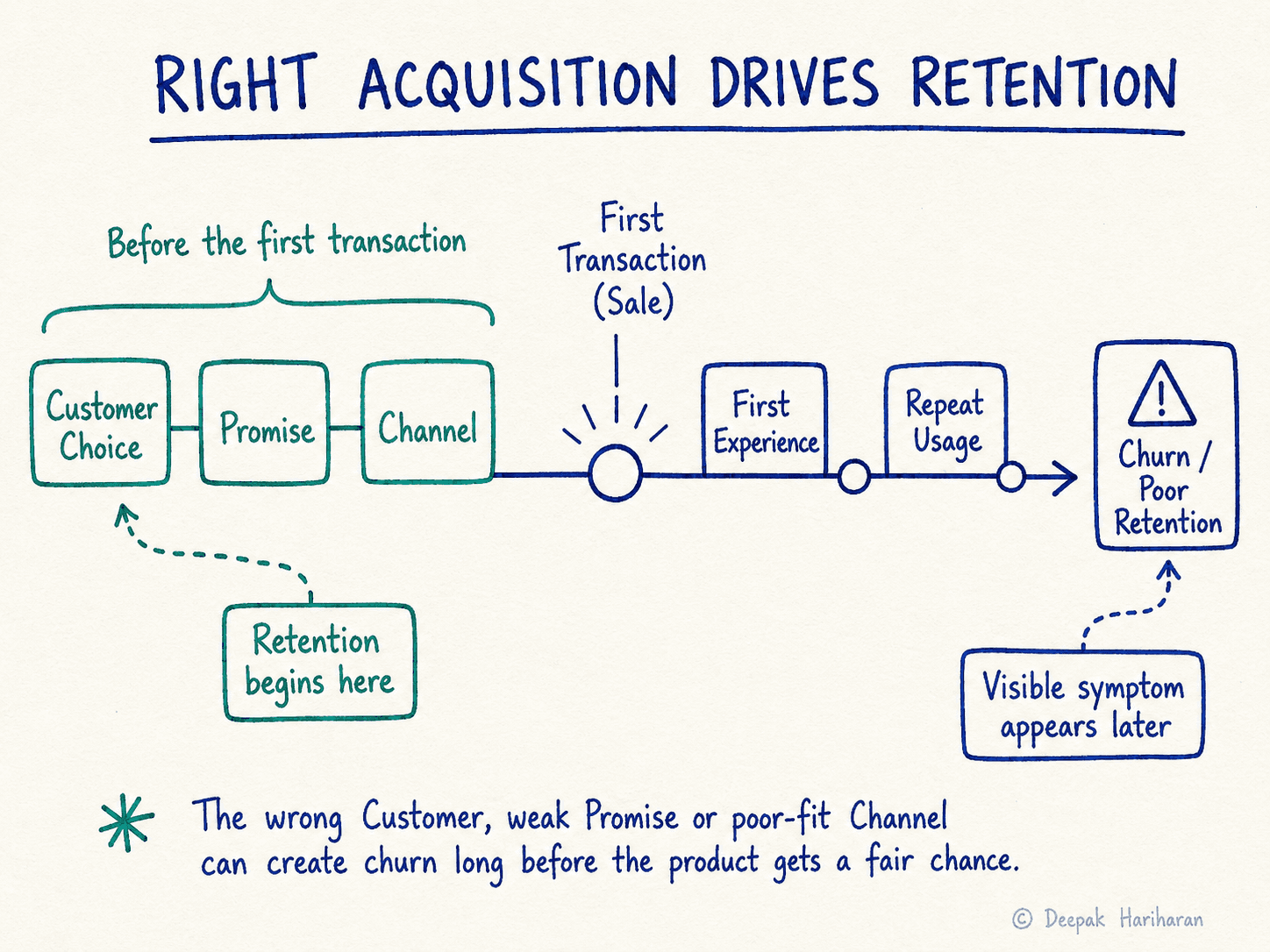
The wrong customer can create churn even when the product or service is delivered well. Why?
The customer may not have a strong enough need.
The buying decision may have been driven mainly by a discount.
The sales pitch may have created expectations that the product was never designed to meet.
The channel may have attracted high-volume but low-intent demand.
In each of these cases, the visible problem appears later as poor retention. But the Real Constraint may sit in acquisition.
This is why acquisition quality matters as much as (or more than) acquisition volume.
The business needs to understand which customers experience the problem most strongly, which promises create the right expectations, which channels bring the best long-term fit and which customers become more valuable after acquisition.
A channel with a low CAC may still produce weak customer economics if those customers leave quickly, need repeated discounts or consume too much service effort. Similarly, a high-conversion sales pitch may create short-term revenue while weakening trust later.
Retention is therefore shaped by Strategic Choices made before the first transaction. The customer, value proposition, positioning, pricing, channel and sales promise all influence what happens after acquisition.
3 - Continuously relevant Value drives Retention
Even the right customer does not stay automatically. Customers stay while the business continues to solve a relevant problem and deliver enough value.
What worked at the time of acquisition may not be enough a year later. Customer needs evolve. Competitors improve. Alternatives become better or cheaper.
The business must continuously ask whether the original problem is still important, whether the product is still the right fit, whether the customer is seeing the promised outcome, whether usage has become easier or harder, and whether the business is adapting as customer needs change.
The headline retention number may still look stable, but the relationship may already be weakening. Usage falls. Complaints rise. Discounts increase. Upsell becomes harder. Referrals decline. Renewal discussions become more difficult. These are early signs that customer value is no longer compounding.
4 - Retention is a full-organization priority
Many businesses treat retention as the responsibility of Customer Success, Account Management, Service or CRM teams.
That is too narrow. Retention is the outcome of several Strategic Choices and Business Capabilities working together.
Sales must acquire the right customer and set the right expectation.
Product must continue solving the problem.
Pricing must remain aligned with the value created.
Operations must deliver consistently.
Service must resolve issues without adding friction.
Leadership must track where value is strengthening or weakening and ensure that the organization responds.
If any one of these breaks, retention suffers.
This is why adding more customer calls or loyalty benefits may create activity without solving the issue. The problem may sit in product relevance, service quality, pricing, delivery or a sales promise that was never realistic.
Retention improves when customer evidence moves across the organization and leads to better decisions. The customer voice should not remain inside support reports. It should influence product choices, channel decisions, pricing, operating priorities and leadership reviews.
Measuring Retention for Diagnosis
Weak Retention eventually appears in the company’s Outcome Metrics through slower Revenue Growth, lower Profitability and greater dependence on continuous acquisition.
The Retention diagnostic begins with the headline Retention number, but then examines the Health Metrics underneath to understand where and why Customer Value is strengthening or weakening.
Aggregate retention can hide where value is strengthening and where it is breaking.
One customer cohort may be highly valuable while another is weak. One product may retain well while another creates early churn. One channel may bring customers who stay, while another brings customers who leave after the first offer. One geography may have strong repeat usage, while another remains expensive and fragmented - reflection of the Business Capabilities there.
Retention should therefore be examined at the level where customer behaviour differs: customer segment, acquisition channel, product, price point, geography, tenure, usage level and cohort.
The purpose is not to create more dashboards. It is to understand where value is being retained, expanded or lost. Useful measures may include retention by cohort, transaction frequency, ticket size or ARPU, contribution margin, referrals, service cost, discount dependence and the time at which engagement begins to weaken.
The right Health Metrics will differ by business. But the diagnostic principle remains the same:
Measure where value retention changes, not only where customers leave.
When retention weakens, leadership teams often increase activity - more calls, more messages, more offers, more renewal reviews. Sometimes this helps. But often the customer is not leaving because the business failed to contact them enough. They are leaving because the value is no longer strong enough.
The visible symptom is churn. The Real Constraint may sit in the customer choice, the initial promise, product relevance, pricing, delivery quality, service experience or the ability to respond to feedback.
A Retention problem may therefore be an Acquisition problem, a Product problem, an Operations problem or an Organization problem.
Before You Move On
Complete these three sentences:
Our highest lifetime value customers are __________________ (mention customer profile).
The Real Constraint weakening Retention is __________________.
The highest-leverage action we will take now is __________________.
If these questions surface an important issue about value retention in your business, I am always open to a thoughtful conversation.